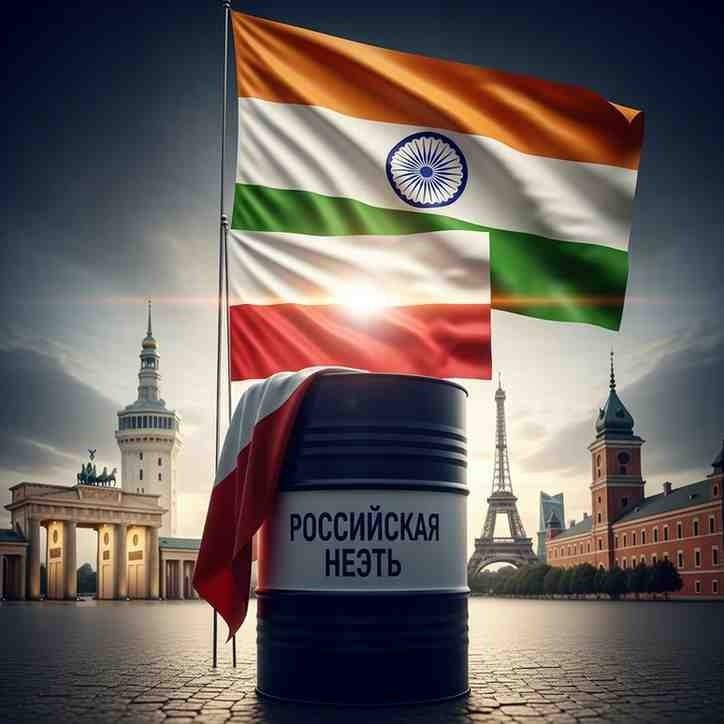
India’s Weimar Triangle Debut Highlights Europe’s Nuanced Stance on Russian Oil Issue
Poland has voiced diplomatic understanding toward India at a time when New Delhi is facing growing pressure from the United States over its purchases of Russian oil. Warsaw’s position comes as Washington sharpens its rhetoric and tariff threats linked to the Ukraine conflict, placing India at the centre of a complex geopolitical balancing act between energy security and global politics.
A Diplomatic First with the Weimar Triangle
India marked a notable diplomatic milestone with its first-ever engagement in the Weimar Triangle format , held in Paris. External Affairs Minister S. Jaishankar joined counterparts from France, Germany, and Poland in discussions focused on global security, geopolitics, and the Ukraine war.
The meeting brought together France’s Foreign Minister Jean-Noël Barrot and Poland’s Foreign Minister Radosław Sikorski , alongside German representatives. India’s participation signalled Europe’s growing interest in engaging New Delhi as a key strategic partner amid shifting global power dynamics.
Poland’s View on India’s Russian Oil Imports
Following the talks, Sikorski publicly stated that Poland was “satisfied” with India’s recent reduction in imports of Russian oil . He acknowledged that energy purchases from Moscow indirectly support Russia’s war effort, but welcomed India’s steps to scale back dependence. Sikorski also noted that discussions on the matter would continue during his upcoming visit to India.
Poland’s stance reflects a broader European effort to persuade major economies to distance themselves from Russian energy supplies, while still recognising the economic and developmental constraints faced by countries like India.
What Is the Weimar Triangle?
The Weimar Triangle is a regional political forum created in 1991 by France, Germany, and Poland . Originally aimed at supporting European integration after the Cold War, the grouping has evolved into a platform for dialogue on security, defence, and relations with Russia and Eastern Europe.
India’s engagement with the Weimar Triangle highlights Europe’s intent to coordinate more closely with New Delhi on global strategic challenges, including energy security, Ukraine, and the broader international order.
India–US Tensions Over Energy and Tariffs
While Poland and parts of Europe have shown diplomatic flexibility, India’s relationship with the United States has come under renewed strain. US President Donald Trump has repeatedly criticised countries that continue to buy Russian oil and has supported legislation that could impose punitive tariffs—up to 500 per cent—on such imports .
Earlier tariff measures and reciprocal trade actions had already pushed duties on certain Indian goods to as high as 50 per cent , adding economic pressure to the diplomatic challenge. India has consistently maintained that its energy decisions are driven by affordability and national interest, especially for a developing economy with large energy needs.
Why This Matters
Poland’s supportive tone, combined with India’s entry into the Weimar Triangle dialogue, suggests that Europe is seeking nuanced engagement rather than outright confrontation with India on the Russia issue. At the same time, escalating US pressure underscores the difficult diplomatic terrain India must navigate as it balances strategic autonomy, energy security, and partnerships with Western powers.
Quick Facts for Exams
Month: Current Affairs - January 10, 2026
Category: diplomatic support from Poland