tensions, indicating that the conflict is entering a more shadowy and escalatory phase.
War Fatigue and Strategic Uncertainty
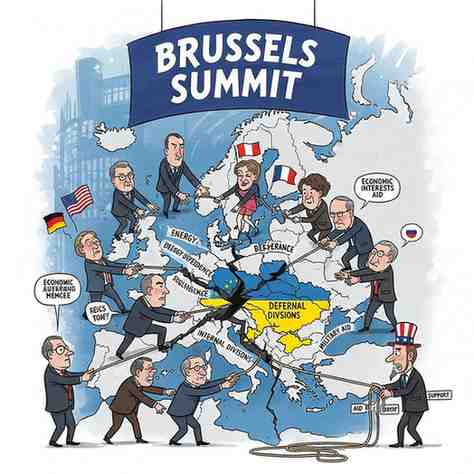
The Brussels summit confirmed a reality increasingly acknowledged by European leaders: fatigue is setting in. There is no unified roadmap for ending the war, only interim measures to manage its economic and security costs.
Russian forces continue to press forward in several key regions, while Moscow appears prepared for a prolonged campaign. The prospect of sustained fighting well into the next year has reinforced European caution and strategic recalibration.
The United States and Shifting Global Alignments
Europe’s uncertainty is compounded by changes in Washington’s approach. Recent diplomatic engagements between Russian and American representatives, along with evolving U.S. strategic documents questioning prolonged NATO expansion, suggest a reassessment of priorities.
The possibility of renewed high-level engagement between Moscow and Washington signals a shift toward managing rivalry rather than escalating confrontation—an adjustment that Europe must now navigate carefully.
Conclusion: From Unity to Risk Management
The EU’s decision to freeze—but not seize—Russian assets reflects more than legal caution. It marks a transition from wartime resolve to pragmatic risk management, from rhetorical unity to uneasy coexistence.
As military realities harden and diplomatic channels cautiously reopen, the Ukraine conflict is entering a new political phase. For Europe, the Brussels summit was a moment of reckoning: an acknowledgment that slogans cannot substitute for strategy, and that the financial, strategic and moral costs of the war are becoming increasingly difficult to contain.
Month: Current Affairs - December 28, 2025
Category: