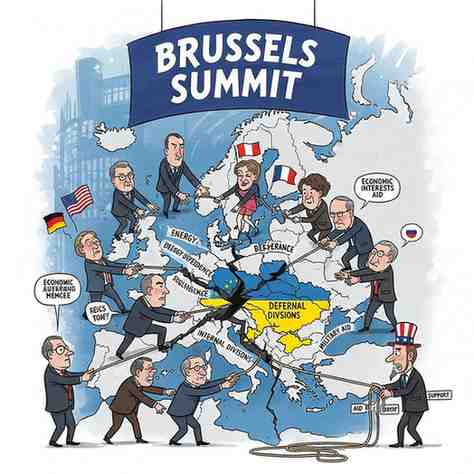
The recent European Union summit in Brussels marked a decisive shift in Europe’s approach to the Ukraine conflict. Instead of confiscating Russia’s frozen sovereign assets—estimated at nearly €210 billion—the EU opted for a more cautious course: raising a €90-billion Eurobond to sustain Ukraine financially. This choice has exposed internal divisions within the bloc, raised concerns about global financial stability, and highlighted growing European fatigue with a war whose political and military endgame remains uncertain.
Why the EU Rejected Asset Seizure
At the centre of the debate were Russia’s frozen assets, largely held at Euroclear in Belgium. While legal mechanisms for confiscation were explored, political and legal resistance ultimately prevailed.
Several EU members, including Belgium, Italy and Austria, argued that outright seizure would violate international legal norms and could trigger retaliatory actions by Russia. Such retaliation, they warned, would impose uneven costs across member states, particularly those hosting Russian assets or maintaining economic exposure. They insisted that any extraordinary step must involve collective burden-sharing, which failed to materialise.
France’s decision to side with Italy rather than Germany proved decisive. Germany had advocated a tougher approach, but without Franco-German alignment, momentum collapsed. The result was a compromise: Russian assets remain frozen indefinitely, but untouched.
The €90-Billion Eurobond: Relief with Long-Term Risks
Instead of using Russian funds, the EU chose to borrow collectively to support Ukraine. The €90-billion Eurobond provides immediate fiscal relief to Kyiv but raises serious long-term questions.
Ukraine’s post-war repayment capacity is highly uncertain, especially given infrastructure destruction and population displacement. The EU has nevertheless committed to servicing the debt, with interest payments estimated at around €3 billion annually. The possible outcomes—debt write-offs, Russian reparations, or a decisive Ukrainian victory—each carry political and financial risks, particularly for European taxpayers already under economic strain.
Cracks in Europe’s Leadership Core
The summit revealed deeper fractures within the EU’s leadership structure. The traditionally dominant Franco-German partnership appeared weakened. Germany, pressing for bold strategic initiatives, now faces constraints from a more cautious France dealing with high public debt, domestic political pressures and fiscal vulnerability.
This imbalance has undermined hopes of decisive European leadership at a time when unity is most needed. Without alignment between Berlin and Paris, the EU’s ability to pursue ambitious collective action remains limited.
France’s Dual Strategy: Strength and Mediation
Despite its caution on asset seizure, France remains central to Europe’s strategic calculus. As the EU’s only nuclear power and a country with an independent defence industrial base, France has responded to perceived Russian threats by increasing defence spending, expanding weapons production and strengthening reserve forces.
Simultaneously, President Emmanuel Macron has positioned France as a potential diplomatic bridge. Signals from Moscow suggesting openness to dialogue, and the possibility of renewed communication between Macron and President Vladimir Putin, reflect Europe’s growing recognition that the conflict may ultimately require a negotiated settlement rather than a purely military outcome.
Britain and the Escalation of Covert Conflict
Outside the EU framework, the United Kingdom continues to exert influence through intelligence and covert operations. Recent attacks on Russian-linked shipping and sophisticated drone strikes deep inside Russian territory point to capabilities beyond Ukraine’s indigenous capacity.
Russia has responded with strategic signalling, announcing the deployment of advanced hypersonic missiles and air defence systems. High-profile assassinations within Russia have further raised
Month: Current Affairs - December 28, 2025
Category: