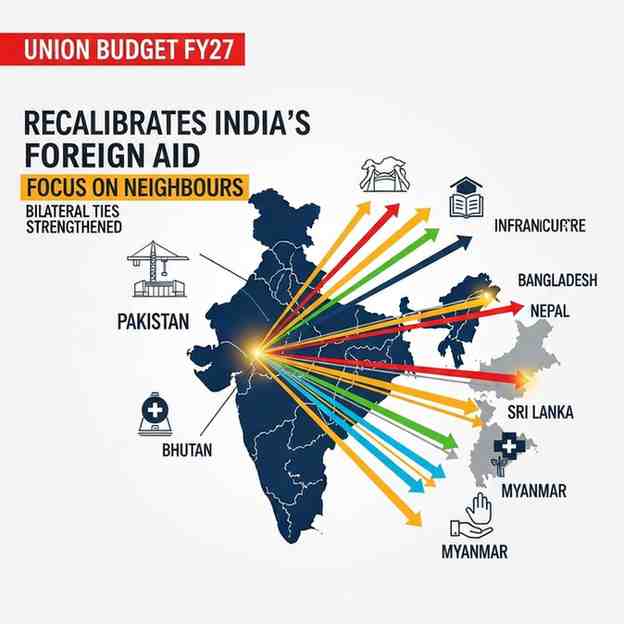
Budget FY27 Redraws India’s Foreign Aid Map
India’s Union Budget for FY27 reflects a strategic recalibration of the country’s foreign assistance programme, combining selective diplomatic signalling with tighter fiscal discipline. Presented by Nirmala Sitharaman , the Budget reveals a pattern of targeted increases for key neighbours alongside sharp cutbacks in other regions, underscoring New Delhi’s effort to manage geopolitical risk while conserving resources.
Increased Support for Bangladesh
Grant assistance to Bangladesh has been raised to Rs60 crore in FY27, representing a 74 per cent increase from Rs34.48 crore in the revised estimates for FY26. Although the Ministry of External Affairs had initially sought Rs120 crore for FY26, the final numbers indicate calibrated engagement rather than expansive aid. The higher allocation signals India’s intent to sustain ties with Dhaka despite periodic political friction and domestic narratives critical of India.
Chabahar Port Funding Withdrawn
One of the most notable changes is the complete withdrawal of grant assistance for the Chabahar Port project in Iran. India had allocated Rs400 crore in FY25 and indicated continued support in FY26. The discontinuation in FY27 is widely seen as a response to heightened US sanctions pressure and concerns over exposure to secondary sanctions, highlighting how external geopolitical constraints are shaping India’s aid decisions.
Redistribution Across Neighbourhood and Beyond
Aid to Afghanistan has been increased by 50 per cent to ₹150 crore, placing it among the top beneficiaries in FY27. Bhutan continues to be India’s largest aid recipient, with a total allocation of Rs2,288 crore—comprising Rs1,769 crore in grants and Rs520 crore in loans—reflecting a 17 per cent increase over FY26.
In contrast, several countries have seen reduced allocations. Assistance to Mauritius has been cut by 33 per cent to Rs550 crore, while Maldives has faced a 12 per cent reduction to the same amount. Nepal’s allocation has dipped marginally by 4 per cent to Rs800 crore. Sri Lanka, however, has seen a 33 per cent increase in grants to Rs400 crore, alongside modest increases for Seychelles, African countries, Eurasian partners, and Latin American states.
Important Facts for Exams
-
Foreign aid is routed through both the Ministry of External Affairs and the Ministry of Finance.
-
Bhutan remains India’s largest foreign aid recipient by value.
-
Grant assistance for Chabahar Port has been discontinued in FY27.
-
India’s total foreign assistance outlay has declined sharply year-on-year.
Overall Decline in External Assistance
Despite selective increases, India’s total grants and loans to foreign governments for FY27 stand at Rs8,792 crore, marking a 27 per cent decline from the revised FY26 estimate of Rs12,107 crore. Of this, Rs6,997 crore will be disbursed through the Ministry of External Affairs and Rs1,794 crore via the Ministry of Finance. The figures suggest a clear shift towards a more focused, risk-aware, and fiscally restrained foreign aid strategy.
Month: Current Affairs - February 02, 2026
Category: International Relations | Economy