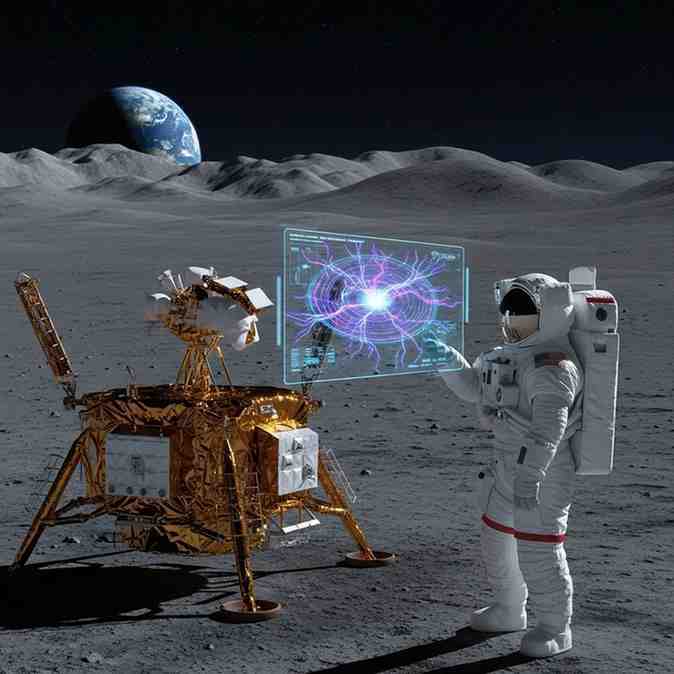
Chandrayaan-3 Uncovers Dense and Energetic Plasma Above the Moon’s South Pole
India’s Chandrayaan-3 mission has delivered a major scientific surprise by revealing that the plasma environment just above the Moon’s south-polar surface is far denser and more energetic than previously believed. Using direct measurements from the Vikram lander , scientists have gained the first in-situ view of near-surface plasma at high lunar latitudes, refining long-held assumptions about the Moon’s ionosphere.
How Lunar Plasma Forms
The Moon lacks a thick atmosphere, yet a thin plasma layer exists due to interactions with the solar wind , photoelectric charging from sunlight and periodic exposure to Earth’s magnetotail . Although plasma is electrically neutral overall, its charged particles respond strongly to electromagnetic forces, influencing surface charging and space-environment conditions.
Key Observations From RAMBHA-LP
The RAMBHA-LP Langmuir Probe , deployed at Shiv Shakti Point , measured electron densities between 380 and 600 particles per cubic centimetre —much higher than earlier estimates derived from remote radio-occultation techniques. Electron temperatures ranged from 3,000 to 8,000 Kelvin , indicating an unexpectedly energetic plasma layer close to the surface.
Dynamic Behaviour Along the Lunar Orbit
Measurements showed clear variability as the Moon moved between sunlit regions and Earth’s magnetic tail . On the dayside, solar-wind interactions dominated plasma generation, while within the magnetotail, Earth-origin particle streams modified plasma density and energy. Scientists also detected evidence of molecular ions , including species linked to carbon dioxide and water vapour, suggesting more complex lunar ionospheric chemistry than previously recognised.
Why These Findings Matter
The results provide critical baseline data for future missions targeting the lunar south pole. Plasma conditions can influence radio communication, surface charging, dust movement and instrument performance . By delivering the first direct measurements, Chandrayaan-3 significantly strengthens India’s contribution to global lunar science.
Exam Point
-
Chandrayaan-3 made the first direct near-surface plasma measurements at the lunar south pole.
-
Electron density recorded: 380–600 cm³ ; temperature: 3,000–8,000 K .
-
Plasma varies with solar wind exposure and entry into Earth’s magnetotail .
-
RAMBHA-LP developed by the Space Physics Laboratory, VSSC .
Month: Current Affairs - December 13, 2025
Category: Space Science, Lunar Exploration