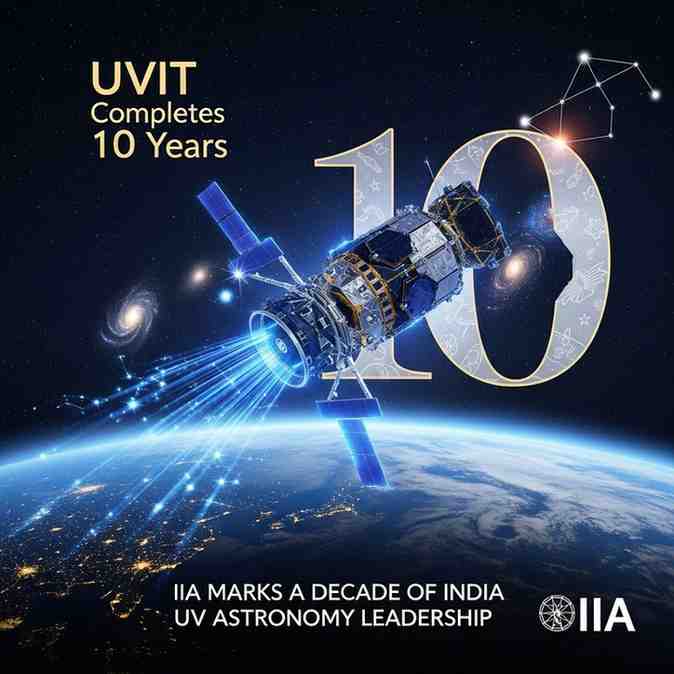
India Celebrates 10 Years of UVIT, AstroSat’s Flagship Ultraviolet Telescope
The Indian Institute of Astrophysics (IIA) has marked a major scientific milestone by celebrating ten years of successful operation of the UltraViolet Imaging Telescope (UVIT), one of the flagship payloads aboard AstroSat. A dedicated workshop in Bengaluru reflected on UVIT’s legacy, its technological sophistication and its foundational role in shaping India’s upcoming ultraviolet astronomy missions.
AstroSat and UVIT’s Impact on Space-Based UV Science
Launched in 2015, AstroSat brought together multiwavelength instruments spanning ultraviolet to hard X-ray bands. UVIT, activated on 30 November 2015, became India’s first UV space telescope and remains one of the few global instruments capable of far-ultraviolet imaging, alongside the Hubble Space Telescope. Since Earth’s atmosphere absorbs UV radiation, UVIT’s decade-long performance has been vital in expanding access to UV astronomy for Indian and international researchers.
Engineering Excellence and Collaborative Development
Designed and developed by IIA at its Hosakote campus, UVIT consists of two co-aligned telescopes—one for near-UV and visible light, and one dedicated to far-UV observations. The project was executed through a national partnership involving IIA, IUCAA, TIFR, multiple ISRO centres and support from the Canadian Space Agency. Key facilities such as the MGK Menon Laboratory and a dedicated Payload Operation Centre ensured high-quality assembly and continuous monitoring of performance.
Scientific Contributions and Global Reach
UVIT’s exceptional spatial resolution of better than 1.5 arcseconds, combined with its wide field of view, has enabled breakthroughs in stellar evolution, galaxy structure and transient events. The telescope has observed 1,451 celestial targets, resulting in nearly 300 publications and 19 PhD theses. Discoveries include hot companions of Be stars, blue stragglers, extended UV-emitting disks in dwarf galaxies, detailed planetary nebula structures, and UV signatures from galaxies at redshift 1.42.
Exam Oriented Facts
-
UVIT activated on 30 November 2015 under AstroSat
-
Spatial resolution: <1.5 arcseconds
-
1,451 targets observed; ~300 research papers generated
-
Jointly developed by IIA, IUCAA, TIFR, ISRO and CSA
Towards the Next Phase: INSIST Mission
The workshop also highlighted INSIST, India’s proposed next-generation UV spectroscopic and imaging mission. Building on two decades of UVIT expertise, INSIST aims to significantly strengthen India’s long-term capabilities in ultraviolet astrophysics. Updated UVIT datasets remain publicly accessible through ISRO’s PRADAN archive.
Month: Current Affairs - December 08, 2025
Category: Indian Space Science