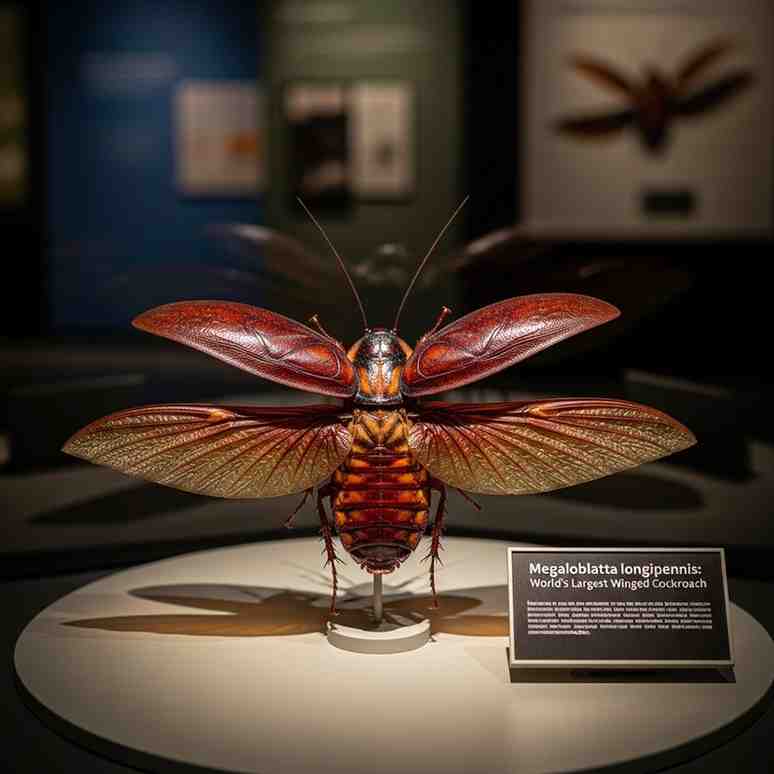
Megaloblatta longipennis: The Giant Winged Cockroach of the Rainforests
Megaloblatta longipennis , the largest known winged cockroach on Earth, remains a subject of scientific curiosity for its exceptional size and specialised adaptations. Native to the dense tropical forests of Peru, Ecuador and Panama, this elusive species has drawn entomological interest since the late 1800s due to its unusual morphology and evolutionary traits.
Unusual Dimensions and Physical Characteristics
The species stands out for its immense size: one preserved female specimen reached 97 mm in body length and 45 mm in width , with some individuals displaying a wingspan approaching 20 cm . Unlike typical household cockroaches, Megaloblatta has an elongated, flattened body, a large shield-like pronotum and strong legs with defensive spines. Its wing structure includes a stiff forewing for protection and a membranous hindwing capable of supporting limited gliding movement through forest undergrowth.
Taxonomic Placement and Scientific Background
Megaloblatta is classified under Animalia, Arthropoda and Insecta, belonging to the order Blattodea. It falls within the superfamily Blaberoidea and the family Ectobiidae. Heinrich Dohrn first described the genus in 1887, and subsequent fieldwork helped differentiate its species from visually similar cockroaches in Central and South America.
Behavioural Studies and Notable Findings
Throughout the 20th century, researchers documented intriguing behaviours such as stridulation , where nymphs generate rasping defensive sounds by rubbing abdominal plates. Expanding surveys also mapped the species’ rainforest distribution, clarifying ecological niches and population variation.
Exam Oriented Facts
-
Largest winged cockroach known globally
-
Maximum size: 97 mm length; wingspan up to 20 cm
-
Genus described by Heinrich Dohrn in 1887
-
Nymphs capable of producing defensive sound signals
Habitat Specialisation and Sexual Dimorphism
Males typically develop longer wings, enabling brief glides between canopy zones, while females have broader bodies suited for carrying egg cases. Individuals living in richer rainforest habitats tend to exhibit larger dimensions. Their slender, flexible bodies and nocturnal habits support efficient navigation through leaf litter, bark crevices and dense vegetation, contributing to their success as forest-dwelling omnivores.
Month: Current Affairs - December 08, 2025
Category: Entomology, Rainforest Ecology