RBI’s December 2025 Policy: Major Liquidity Boost Through OMOs and FX Swap
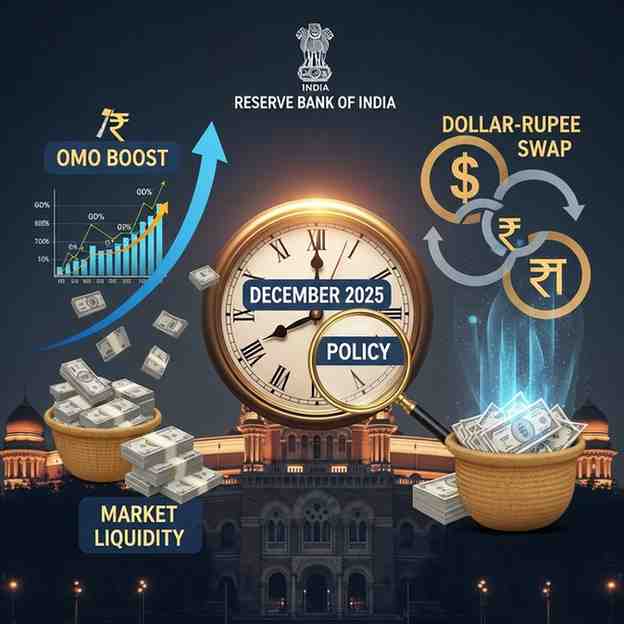
The Reserve Bank of India, in its December 2025 policy review, rolled out substantial liquidity measures to stabilise financial markets and ease the strain caused by the rupee’s recent fall past ₹90 per US dollar. Key initiatives include ₹1 trillion worth of open market operation (OMO) purchases and a three-year dollar–rupee buy/sell swap totalling $5 billion. Together, these tools aim to support monetary transmission and calm currency-driven liquidity pressures.
What OMOs Achieve in the Monetary System
Open market operations form a vital lever for liquidity management. When the RBI purchases government securities , it injects durable liquidity into the banking system, enabling banks to extend credit more comfortably. Conversely, OMO sales absorb surplus funds. During periods of currency volatility — such as sharp rupee depreciation — liquidity often tightens because banks’ demand for dollars rises. OMO purchases counterbalance this stress, helping maintain orderly money-market functioning.
Why OMOs Differ from Short-Term Liquidity Tools
The governor clarified that OMOs target long-term or durable liquidity , supporting overall financial stability. In contrast, instruments like the repo window and variable rate operations address day-to-day mismatches. These short-term tools keep the weighted average call rate aligned with the policy repo rate, currently fixed at 5.25% . It is common for the RBI to inject long-duration liquidity yet drain short-term excess through VRRs, depending on prevailing conditions.
Exam Oriented Facts
-
RBI announced ₹1 trillion OMO purchases in Dec 2025
-
A $5 billion 3-year buy/sell swap was launched to manage FX pressure
-
OMOs adjust durable liquidity; repos handle short-term mismatches
-
Policy repo rate: 5.25%
Policy Context and Growth Outlook
Despite global uncertainty, the RBI reaffirmed optimism over India’s growth trajectory. With inflation moderating, the central bank signalled space for supportive interventions that preserve liquidity, enhance transmission and sustain financial stability.
Month: Current Affairs - December 08, 2025
Category: RBI Monetary Policy