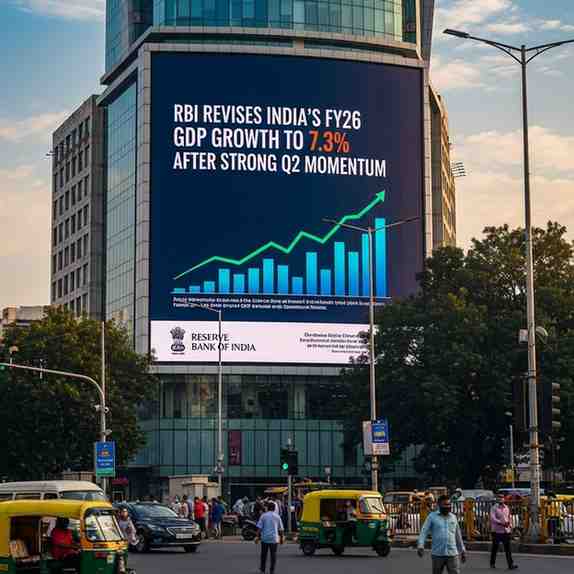
RBI Raises India’s FY26 GDP Growth Forecast to 7.3%
The Reserve Bank of India has sharply upgraded India’s GDP growth outlook for FY2025–26 , revising its estimate from 6.8% to 7.3% . The announcement, made after the latest Monetary Policy Committee (MPC) meeting, reflects the economy’s robust performance in recent quarters, alongside supportive fiscal measures and improving rural demand. The revision was accompanied by a 25 bps repo rate cut , bringing the policy rate down to 5.25% to further strengthen economic momentum.
Why the RBI Upgraded the Growth Projection
1. Strong Q2 GDP Performance
India recorded 8.2% GDP growth in Q2 FY25 , the fastest in six quarters. Key contributors included:
-
Festive-season consumption surge
-
GST rate rationalisation boosting purchasing power
-
Government’s front-loaded capital expenditure
-
Reduced crude oil prices improving cost structures and trade balance
2. Policy Reforms Supporting Demand
Recent reforms have bolstered consumer sentiment:
-
Simplified two-rate GST structure (5% and 18%)
-
Reduced taxes on essential consumer categories
-
Rural demand recovery driven by improved agricultural output
Updated RBI Growth Projections
-
FY26 : 7.3% (earlier 6.8%)
-
Q3 FY26 : 7.0% (from 6.4%)
-
Q4 FY26 : 6.5% (from 6.2%)
-
Q1 FY27 : 6.7%
-
Q2 FY27 : 6.8%
The trajectory suggests sustained expansion supported by domestic demand and macroeconomic stability.
Monetary Support Through Repo Rate Reduction
The MPC’s decision to lower the repo rate to 5.25% aims to:
-
Stimulate credit and investment
-
Strengthen consumption
-
Cushion India from global economic volatility
RBI emphasised that inflation remains manageable, allowing room for growth-oriented policy action.
India’s Position in Global Rankings
As per the IMF’s 2025 World Economic Outlook , India is poised to become the world’s 4th largest economy by FY26 , surpassing Japan. This continues a decade-long rise driven by structural reforms, digitalisation, and resilient services activity.
Exam-Oriented Facts
Month: Current Affairs - December 06, 2025
Category: RBI Monetary Policy, India GDP Forecast