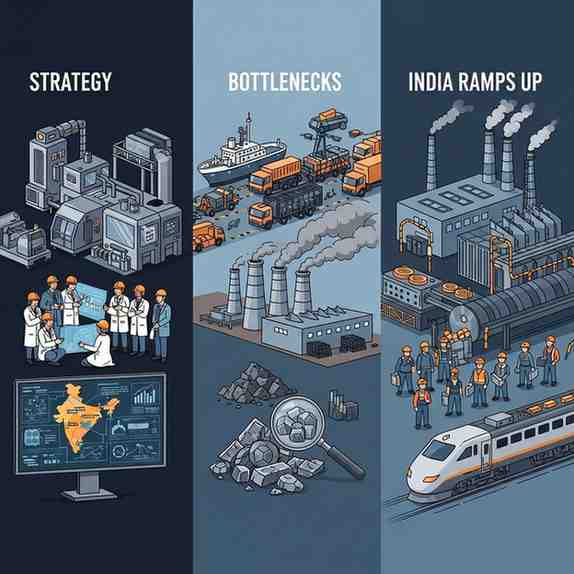
India Steps Up Rare Earth Value Chain Development Amid Global Supply Disruptions
India is intensifying efforts to establish a self-reliant rare earth ecosystem after China’s recent export restrictions highlighted the fragility of global supply chains. With rare earth magnets forming the backbone of electric mobility, defence systems and advanced electronics, policymakers are prioritising a coordinated national strategy to reduce import dependence and strengthen domestic industrial capacity.
Growing Strategic Significance of Rare Earth Magnets
High-performance magnets such as NdFeB (Neodymium-Iron-Boron) and Sm-Co (Samarium-Cobalt) are indispensable for EV motors, drones, radars, wind turbines and precision-guided defence platforms. Although India possesses nearly 7 million tonnes of rare earth reserves and produces precursor oxides like Nd and Nd-Pr , domestic magnet-making remains minimal. Low-cost Chinese imports, technology gaps and limited midstream capacity have hindered India’s progress in this critical sector.
Rising Demand and Supply Chain Vulnerabilities
China’s 2025 export control measures exposed India’s near-total reliance on foreign magnets—almost 100% of domestic requirements are imported. With magnet demand projected to rise from ~2 kiloton (FY25) to ~6 kiloton (FY30) , establishing a stable value chain is essential for achieving EV30@30 targets and aligning with India’s China+1 diversification strategy.
Key Barriers to Local Manufacturing
India’s monazite-based ores contain lower rare earth concentrations and require strict radiological safeguards, making extraction and separation more challenging. Technological capabilities remain fragmented, with limited experience in downstream metallisation and magnet fabrication. Regulatory frameworks, especially around private-sector involvement under IREL and the Department of Atomic Energy, continue to evolve.
Exam Oriented Facts
-
India has ~7 million tonnes of rare earth reserves.
-
Nearly 100% of rare earth magnets are imported.
-
Demand may triple from ~2 kt (FY25) to ~6 kt (FY30).
-
China controls ~90% of global rare earth processing.
Towards Self-Reliance: Innovation, Incentives and Circularity
Experts recommend forming a national rare earth council to synchronise R&D and accelerate Indian capabilities in Nd metal extraction and NdFeB magnet production. Incentive schemes similar to ACC-PLI could reduce investment risk and attract private participation. Establishing a magnet recycling framework—including recovery from EV motors, wind turbines and electronics—would enhance sustainability and secure long-term supply.
By bridging technological, regulatory and industrial gaps, India aims to transition from a raw-material supplier to a globally competitive rare earth magnet manufacturer, reinforcing economic security and strategic autonomy.
Month: Current Affairs - December 05, 2025
Category: rare earth value chain