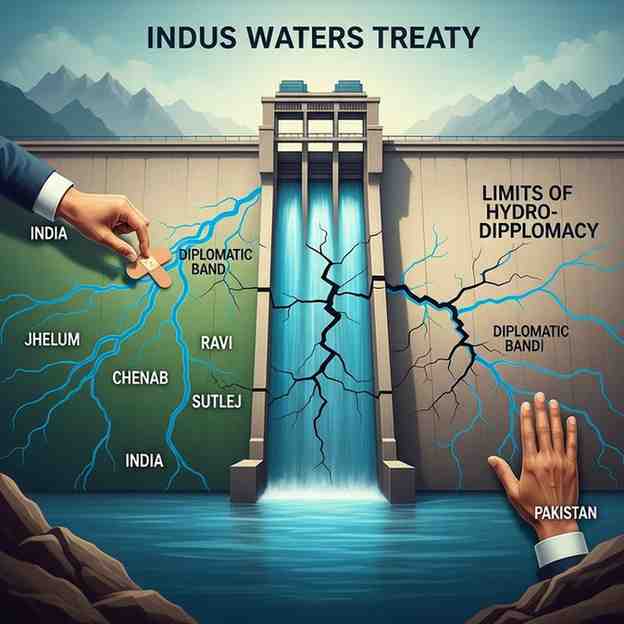
Indus Waters and Strategic Reality: How Much Leverage Does India Really Have?
External Affairs Minister S Jaishankar ’s remarks at IIT Madras, echoing Prime Minister Narendra Modi ’s assertion that “blood and water cannot flow together”, have once again brought the Indus rivers into sharp political focus. The statement reflects India’s anger over decades of cross-border terrorism, but it also raises a harder, more technical question: beyond rhetoric, how much leverage does India actually possess over the waters that flow into Pakistan?
The treaty that governs the rivers
At the centre of the debate lies the Indus Waters Treaty (IWT), signed in 1960 after prolonged negotiations brokered by the World Bank . The treaty governs six rivers of the Indus system. India was granted exclusive rights over the eastern rivers—Ravi, Beas and Sutlej—while Pakistan received the western rivers—Indus, Jhelum and Chenab.
In volumetric terms, this meant that Pakistan obtained access to nearly 80% of the system’s waters, with India retaining only about 20%. For Pakistan’s irrigation-dependent economy, the treaty became foundational to food and water security. For India, it represented a significant concession aimed at long-term stability.
Fear versus geography
Pakistan’s historical anxiety stemmed from India’s position as an upper riparian. The fear was that India could, in theory, disrupt flows downstream. In practice, geography sharply limits this possibility. The Indus flows through narrow, high-altitude terrain in Ladakh before entering Pakistan-occupied Kashmir, making large storage dams or diversions virtually impossible. The Jhelum faces similar constraints.
The Chenab offers relatively more scope, but even here the treaty restricts India to run-of-the-river hydropower projects with minimal storage. These projects allow electricity generation but not the capacity to hold back or regulate water flows seasonally. In essence, physical terrain and treaty rules together constrain India’s leverage.
What India can—and cannot—do
India can fully exploit the eastern rivers, but they constitute a small share of the overall system. On the western rivers, India’s rights are limited to:
-
Run-of-the-river hydropower projects
-
Small-scale irrigation and domestic use
-
Long-delayed projects such as the Tulbul Navigation Project
What India cannot do is meaningfully “turn off the tap” to Pakistan. Large-scale storage, diversion, or sustained withholding of water is neither technically feasible nor legally permissible under existing conditions.
Why India has hardened its stance
After the Pahalgam terror attack , India placed the treaty in abeyance and earlier sought its renegotiation, arguing that circumstances have changed since 1960—particularly climate variability, energy needs and persistent terrorism. Pakistan, however, insists that all issues be addressed strictly within the treaty’s dispute-resolution mechanisms, resisting broader political renegotiation.
Pakistan’s warnings that water disruption would amount to an “act of war” reflect vulnerability more than deterrence. The country is now water-stressed, largely due to inefficient irrigation, population growth and poor management, rather than Indian actions alone.
Why Pakistan wants the treaty intact
Predictability is Pakistan’s biggest stake in the IWT. Even marginal uncertainty about flows can disrupt agriculture during critical sowing
Month: Current Affairs - January 18, 2026
Category: