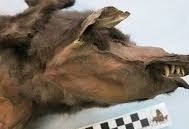
Ice Age Discovery: Woolly Rhinoceros Genome Recovered from Wolf Puppy’s Stomach
In a remarkable scientific breakthrough, researchers have recovered a complete genome of the woolly rhinoceros from undigested stomach contents of a 14,400-year-old wolf puppy preserved in Siberian permafrost. The puppy, discovered near the village of Tumat in northeastern Siberia , had consumed meat from a woolly rhinoceros shortly before its death, providing scientists with an unprecedented genetic window into the final days of this iconic Ice Age species.
Genome Recovered from a Unique Permafrost Find
The wolf puppy, only a few weeks old at the time of death, was exceptionally well preserved due to permafrost conditions . Researchers extracted DNA from a chunk of undigested rhinoceros meat found in its stomach. This rare preservation allowed scientists to reconstruct a high-quality genome of the woolly rhinoceros ( Coelodonta antiquitatis ), a cold-adapted herbivore that once ranged across northern Europe and Asia.
Such genome recovery from stomach contents is a scientific first, demonstrating how indirect biological material can yield major evolutionary insights.
What the Genome Reveals About Extinction
The newly recovered genome was compared with genomes from two other woolly rhinoceroses that lived around 18,000 years and 49,000 years ago . The comparison revealed that woolly rhinoceroses maintained strong genetic diversity until very close to their extinction .
Importantly, scientists found no signs of prolonged inbreeding or gradual population decline , suggesting the species did not slowly fade away. Instead, it appears to have undergone a rapid collapse , coinciding with dramatic environmental changes at the end of the last Ice Age.
Climate Change, Not Humans, as the Main Driver
Researchers concluded that abrupt climate warming around 14,000 years ago likely caused the disappearance of the steppe-tundra ecosystem , the primary habitat and food base of the woolly rhinoceros. This sudden ecological shift appears to have triggered the species’ extinction.
Although humans were present in the region at the time, genetic evidence and limited archaeological data indicate that human hunting pressure was not the dominant cause of extinction, reinforcing the role of climate-driven habitat loss.
Scientific Importance of the Study
The study was published in Genome Biology and Evolution and led by evolutionary geneticist Solveig Gudjonsdottir , with co-senior author Love Dalén from the Centre for Palaeogenetics , a collaboration between Stockholm University and the Swedish Museum of Natural History.
The research highlights that valuable genomes can be recovered even from unconventional or partially degraded material , opening new avenues for studying extinct species and understanding how rapid climate change has shaped biodiversity loss in the past.
Exam-Focused Points
-
Scientific name of woolly rhinoceros: Coelodonta antiquitatis
-
Species went extinct around 14,000 years ago at the end of the last Ice Age
-
Genome recovered from undigested stomach contents preserved in permafrost
Month: Current Affairs - January 18, 2026
Category: Evolutionary Biology | Climate Change