the e-NAM platform, improving price discovery and enabling farmers to access markets beyond local mandis. Parallelly, the formation of 10,000 Farmer Producer Organisations (FPOs) emerged as a structural reform, enhancing collective bargaining, input procurement and value addition—especially for smallholders and women farmers.
Allied sectors became decisive drivers of income diversification. India retained its position as the world’s largest milk producer, with output exceeding 239 million tonnes. Fisheries production reached 195 lakh tonnes, and horticulture and food processing exports crossed USD 49 billion by mid-2025. These sectors reduced dependence on crop income and strengthened rural resilience.
Sustainability and the Energy Transition
Sustainability moved from rhetoric to practice. Natural and organic farming expanded under dedicated missions, while the Soil Health Card scheme promoted balanced nutrient use. The ethanol blending programme achieved over 19% blending by July 2025, lowering import dependence and creating new income streams for sugarcane farmers. Renewable energy adoption under PM-KUSUM further integrated agriculture with India’s clean energy transition.
Conclusion
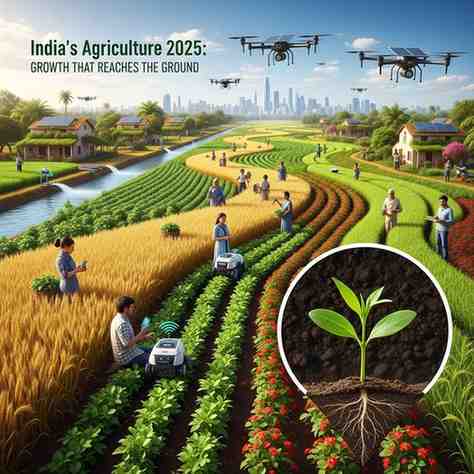
India’s agricultural performance in 2025 demonstrated that growth can indeed “reach the ground” when productivity, income assurance, infrastructure and sustainability are pursued together. While challenges remain—climate volatility, regional disparities and farm size fragmentation—the year marked a transition from episodic support to systemic strengthening. Agriculture in 2025 was not merely feeding the nation; it was laying the foundation for resilient rural prosperity and inclusive economic growth.
Month: Current Affairs - December 31, 2025
Category: