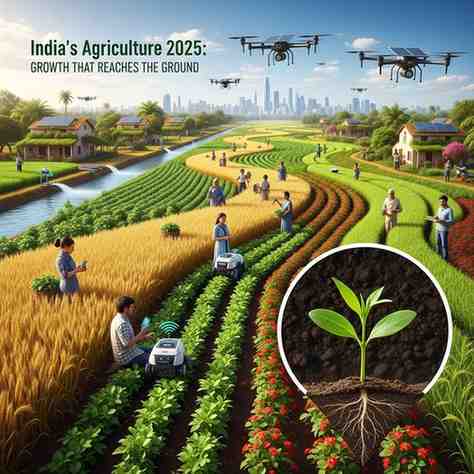
In 2025, Indian agriculture stood at a critical juncture where growth was no longer confined to macro statistics but increasingly visible at the grassroots. After decades of being characterised by subsistence farming, income uncertainty and climatic vulnerability, the sector reflected the cumulative impact of sustained public investment, policy continuity and institutional reform. Contributing nearly 16% to India’s GDP in FY 2024–25 and supporting the livelihoods of about 46% of the population, agriculture reaffirmed its central role in economic stability, food security and rural transformation.
Record Production and the Productivity Turnaround
One of the most striking markers of 2025 was India’s record foodgrain production of 357.73 million tonnes in 2024–25—an increase of 8% over the previous year and over 100 million tonnes higher than a decade ago. Rice and wheat achieved historic highs, with production touching 150.18 million tonnes and 117.95 million tonnes respectively. Pulses, oilseeds, maize and millets also recorded robust growth.
This performance was not accidental. It reflected better seed availability, targeted crop missions, improved irrigation coverage and assured procurement. The renewed emphasis on millets—rebranded as Shree Anna —signalled a strategic shift toward climate-resilient and nutrition-rich crops, aligning farm policy with sustainability and public health goals.
MSP and the Architecture of Income Assurance
Minimum Support Price (MSP) policy remained the backbone of income stability for farmers. By guaranteeing at least a 50% return over the cost of production for all mandated crops, MSP continued to provide planning certainty and production incentives. Since 2014, procurement payments for paddy and wheat alone have exceeded ₹20 lakh crore, representing an unprecedented transfer of income to rural households.
Equally important was the expansion of procurement for pulses and oilseeds such as tur, urad, chana and moong. This helped correct long-standing price volatility in these crops and encouraged diversification beyond rice and wheat, addressing both nutritional and ecological concerns.
Direct Income Support and Credit Deepening
Direct Benefit Transfer under PM-Kisan Samman Nidhi emerged as a critical stabiliser of farm incomes. By August 2025, transfers had reached nearly ₹3.90 lakh crore through 20 instalments, benefiting over 11 crore farmers. While modest in size, the predictability of this income support helped farmers manage consumption needs and input purchases.
Institutional credit access expanded alongside income support. Agricultural credit under the Kisan Credit Card programme crossed ₹10 lakh crore, covering 7.71 crore farmers. Importantly, credit outreach improved among small and marginal farmers, as well as livestock and fisheries stakeholders, signalling a broader understanding of agriculture as a diversified livelihood system rather than crop cultivation alone.
Risk Mitigation, Irrigation and Infrastructure
Risk management gained depth through the Pradhan Mantri Fasal Bima Yojana (PMFBY). Since 2016, claims worth ₹1.83 lakh crore have been paid, with rising participation by non-loanee farmers in 2024–25. This reduced income shocks and strengthened confidence in adopting improved practices.
Irrigation expansion under the Pradhan Mantri Krishi Sinchai Yojana accelerated the completion of long-pending projects and boosted micro-irrigation. Better water-use efficiency enabled farmers to shift toward high-value crops, reinforcing the link between irrigation and income growth.
Infrastructure investment further bridged the gap between production and markets. Under the Agriculture Infrastructure Fund, over one lakh projects strengthened storage, warehousing, cold chains and processing capacity. This reduced post-harvest losses, limited distress sales and generated rural employment.
Markets, Collectives and Allied Sectors
Market reforms advanced through the expansion of
Month: Current Affairs - December 31, 2025
Category: