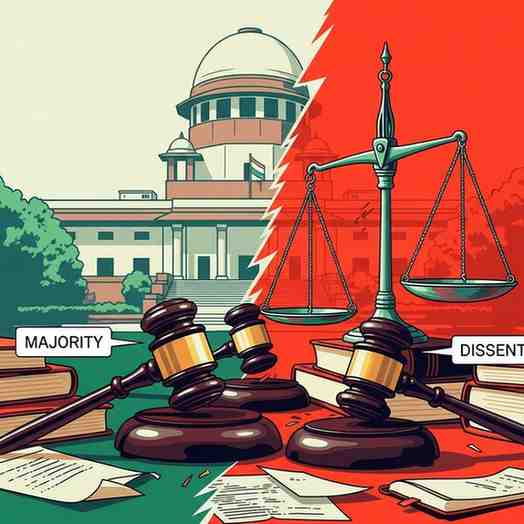
Supreme Court Split on Section 17A: What the Verdict Means
The Supreme Court recently delivered a split verdict on the constitutional validity of Section 17A of the Prevention of Corruption Act, 1988 , a provision that requires prior approval before initiating any enquiry or investigation against a public servant for actions taken in official capacity.
With the two-judge bench divided, the issue will now be placed before the Supreme Court of India Chief Justice for reference to a larger bench, setting the stage for a decisive ruling with long-term implications for governance and anti-corruption enforcement.
What Is Section 17A of the Prevention of Corruption Act?
Section 17A was introduced through the 2018 amendment to the Prevention of Corruption Act. It prohibits investigative agencies from starting any enquiry, inquiry, or investigation against a serving or former public servant without prior sanction from the competent authority, provided the alleged offence relates to decisions or recommendations made in the discharge of official duties.
The stated objective behind this provision is to protect honest officials from harassment due to vexatious or politically motivated complaints. However, critics argue that it creates an additional procedural shield that can delay or obstruct corruption probes.
Origin of the Legal Challenge
The constitutional validity of Section 17A was challenged through a public interest litigation filed by the Centre for Public Interest Litigation (CPIL) . The petition contended that mandatory prior approval at the very inception of investigation undermines the core purpose of anti-corruption law , which is timely and independent inquiry into corruption allegations.
Divergent Judicial Reasoning
View 1: Section 17A Is Unconstitutional
Justice B V Nagarathna struck down Section 17A as unconstitutional. She reasoned that placing a sanction requirement at the threshold stage effectively blocks investigation before facts can even be ascertained.
According to her, the provision weakens the statutory framework of the Prevention of Corruption Act and risks institutionalising impunity by insulating corrupt officials under the guise of administrative protection.
View 2: Section 17A Is Constitutionally Valid
Justice K V Viswanathan upheld the provision, emphasising the practical realities of governance. He observed that policy decisions and administrative judgments are often second-guessed with the benefit of hindsight.
In his view, eliminating prior sanction altogether would expose honest officers to frivolous and retaliatory probes , discouraging decisive governance. Striking down Section 17A, he cautioned, could do more harm than good.
Reference to a Larger Bench
Due to the split verdict, the matter will now be placed before Justice Surya Kant for constitution of a larger bench. The final ruling is expected to clarify the constitutional boundaries of prior sanction provisions and reconcile the competing goals of administrative efficiency and accountability.
Why This Case Matters
The eventual verdict will significantly influence how corruption cases involving public servants are investigated in India. It will determine whether prior sanction operates as a protective filter or becomes a procedural barrier
Month: Current Affairs - January 14, 2026
Category: Anti-Corruption Laws