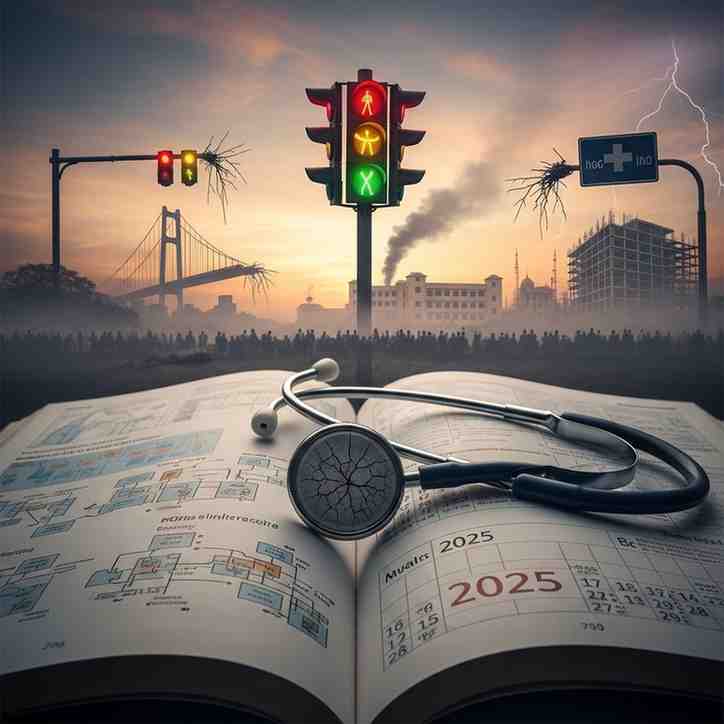
With a population nearing 146 crore, India’s health-care system faces challenges unmatched in scale and complexity. The year 2025 laid bare the system’s underlying fragility — not through a single crisis, but through a convergence of pressures: resurging infectious diseases, a growing non-communicable disease burden, antimicrobial resistance, air pollution, pharmaceutical safety failures, and chronic underfunding. Together, these stresses have underscored an urgent truth: India’s health priorities need realignment, not incremental adjustment.
A Funding Shock That Exposed Vulnerability
One of the most destabilising events of 2025 came from outside India. The United States’ withdrawal from the World Health Organization and subsequent cuts to global health assistance abruptly reduced funding for key programmes in India. Support for HIV/AIDS, maternal and child health, and population services — long backed by PEPFAR and USAID — declined sharply.
Although India is no longer aid-dependent, the sudden funding gap revealed how international assistance had been quietly embedded into critical public health programmes. Union and State governments were forced to reallocate funds at short notice, often without prior budgetary planning, exposing the lack of financial buffers in health governance.
Persistent Underinvestment in Public Health
This external shock was magnified by India’s long-standing underinvestment in health. Public health expenditure remains below 2% of GDP, far short of the National Health Policy target of 2.5%. The Union Budget for 2025–26 allocated just under ₹1 lakh crore to health — an increase in nominal terms, but insufficient relative to population growth, inflation, and rising disease burdens.
While post-pandemic investments expanded diagnostic capacity and hospital infrastructure, funding has not kept pace with epidemiological transition. India is now battling infectious diseases and lifestyle-related illnesses simultaneously, stretching an already overburdened system.
The Quiet Return of Infectious Diseases
Inadequate funding has tangible consequences. Several infectious diseases have shown signs of resurgence, testing surveillance networks, laboratories and frontline workers. The challenge is no longer merely outbreak containment, but reducing preventable deaths and long-term disability — outcomes that require sustained, predictable investment rather than emergency responses.
These pressures coexist with a heavy non-communicable disease load, increasing demand for long-term care, medicines and specialised personnel.
Air Pollution as a Health Emergency
Air pollution has emerged as one of India’s most severe public health threats. Seasonal smog, particularly in northern India, has become a recurring health emergency, aggravating respiratory and cardiovascular conditions. Children, the elderly and those with pre-existing illnesses bear the brunt.
Unlike episodic disease outbreaks, pollution exerts a slow but cumulative toll. Without aggressive, coordinated action — comparable to China’s multi-sectoral interventions — deterioration is likely to continue. Air quality is no longer an environmental issue alone; it is a central determinant of population health.
Tuberculosis: Ambition Outpacing Capacity
India’s failure to meet its self-imposed goal of eliminating tuberculosis by 2025 highlights the limits of ambition without adequate capacity. Advances such as molecular diagnostics and newer drug regimens have improved detection and treatment. Indigenous tools like TrueNat have strengthened early diagnosis.
Yet multidrug-resistant TB continues to rise, and detection rates vary widely across States. Weak follow-up systems, workforce shortages and uneven funding have prevented sustained progress. TB elimination remains possible, but not without deeper investment and systemic strengthening.
Antimicrobial Resistance: A Looming Crisis
Antimicrobial resistance (AMR) represents
Month: Current Affairs - December 30, 2025
Category: