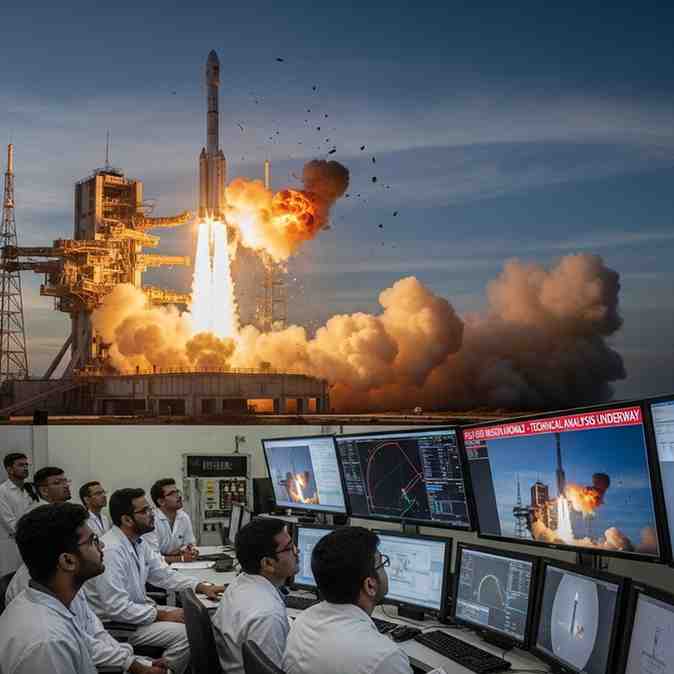
India's First 2026 Space Launch Encounters Third-Stage Disturbance
India's inaugural space mission of 2026, the PSLV-C62 launch, commenced successfully but subsequently encountered a technical anomaly. The Indian Space Research Organisation (ISRO) initiated the mission, which faced an unexpected disturbance near the conclusion of its third-stage burn, leading to a comprehensive review of flight data.
Launch from Sriharikota and Mission Profile
ISRO's Polar Satellite Launch Vehicle (PSLV) lifted off from the First Launch Pad at the Satish Dhawan Space Centre in Sriharikota, Andhra Pradesh. The rocket's primary payload was the Earth Observation Satellite EOS-N1, accompanied by 14 co-passenger satellites for various domestic and international customers. This flight represented the 64th overall mission for the PSLV and the ninth dedicated commercial venture managed by NewSpace India Limited (NSIL).
ISRO Flags Disturbance During PS3 Stage
ISRO Chairman V. Narayanan reported that the vehicle's performance was nominal through the initial phases of the flight. However, close to the end of the third stage (PS3) operation, engineers observed heightened disturbance levels in the vehicle's dynamics, followed by a deviation from the intended flight path. ISRO has confirmed the initiation of a detailed technical analysis to determine the root cause and assess the mission's overall impact.
Vehicle Configuration and Payload Details
The PSLV-C62 mission employed the DL configuration, featuring a four-stage design with two solid strap-on boosters. The vehicle stands 44.4 meters tall with a lift-off mass of approximately 260 tonnes. The primary satellite, EOS-N1, is an earth observation spacecraft developed through a partnership involving Thailand and the United Kingdom, destined for a Sun-synchronous orbit.
Additional Demonstrations and Commercial Significance
Beyond satellite deployment, the mission also aimed to demonstrate the 'Kestrel' Initial Technology Demonstrator, a prototype re-entry vehicle developed by a Spanish startup. Despite the in-flight anomaly, the mission underscores ISRO's and NSIL's ongoing commitment to expanding commercial launch services and facilitating advanced in-orbit technology demonstrations.
Exam-Focused Points:
-
PSLV is a four-stage launch vehicle with alternating solid and liquid fuel stages.
-
The PSLV-C62 mission was the 64th flight of the PSLV series.
-
A Sun-synchronous orbit ensures a satellite passes over a location at the same local solar time each day.
-
NewSpace India Limited (NSIL) is ISRO's commercial arm responsible for operationalizing launch and satellite services.
-
The mission carried the primary satellite EOS-N1 and 14 co-passenger satellites.
Month: Current Affairs - January 13, 2026
Category: Space Technology