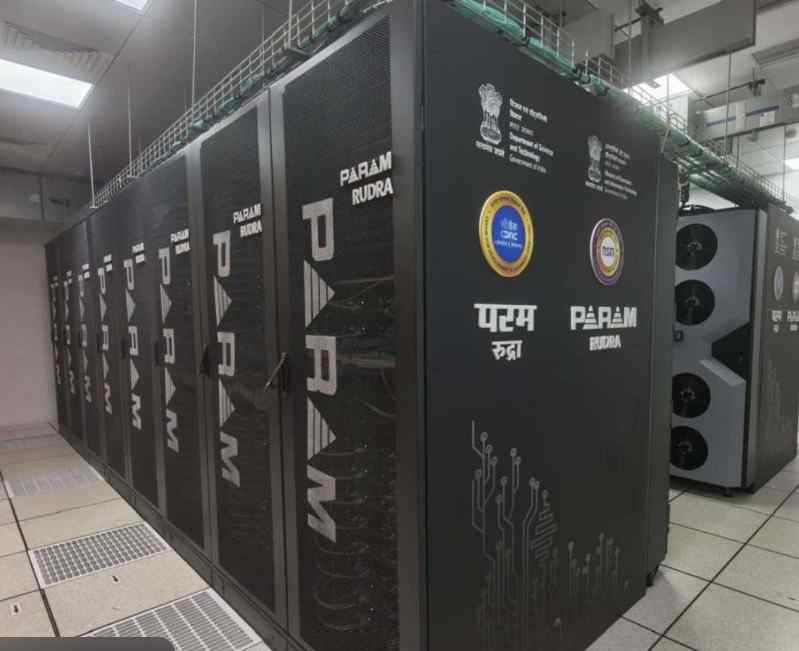
IIT Madras Unveils ‘Param Shakti’, Strengthening India’s Indigenous Supercomputing Power
The Indian Institute of Technology Madras has commissioned Param Shakti , a state-of-the-art indigenous supercomputing system, marking a significant advance in India’s high-performance computing (HPC) ecosystem. With a peak capacity of 3.1 petaflops , the system ranks among the country’s most powerful academic supercomputers and reinforces India’s drive towards technological self-reliance in digital infrastructure.
Performance Capability and Indigenous Architecture
Param Shakti is capable of performing more than 3.1 quadrillion calculations per second , enabling researchers to process massive datasets and complex simulations with high efficiency. The system has been designed and manufactured entirely in India by IIT Madras in collaboration with Centre for Development of Advanced Computing (C-DAC).
Built on C-DAC’s RUDRA server platform, the supercomputer operates on open-source software frameworks, aligning with India’s policy emphasis on open and indigenous digital technologies.
Accelerating Advanced Scientific Research
The new supercomputing facility is expected to dramatically enhance research productivity across multiple domains. It will support high-resolution simulations and modelling in areas such as aerospace engineering, advanced materials, climate and weather modelling, drug discovery, artificial intelligence, and next-generation manufacturing processes.
By reducing computation time and improving modelling accuracy, Param Shakti will allow Indian researchers to address frontier scientific problems and collaborate competitively at the global level.
Integration with National Supercomputing Infrastructure
Param Shakti will function as part of the Param Rudra supercomputing cluster at IIT Madras, supported by advanced data centre infrastructure, energy-efficient cooling systems, and uninterrupted power supply.
The project has been funded under the National Supercomputing Mission , jointly implemented by the Ministry of Electronics and Information Technology and the Department of Science and Technology . The mission aims to build a nationwide network of HPC facilities accessible to academia, industry, and government.
Inauguration and Mission Outlook
The system was inaugurated by S Krishnan in the presence of V Kamakoti and E Magesh . Under the National Supercomputing Mission, 37 supercomputers have already been deployed across Indian institutions, with additional large-scale systems planned, including a flagship installation in Bengaluru.
The mission also promotes the use of multiple GPU and processor architectures to ensure broad-based skill development and technological resilience.
Key Exam-Focused Points
-
Petaflop equals 10¹5 computing operations per second.
-
Param Shakti delivers 3.1 petaflops of peak performance.
-
The National Supercomputing Mission aims to create a pan-India HPC ecosystem.
-
C-DAC is the nodal agency for indigenous supercomputer development.
-
Open-source software is a core component of India’s HPC strategy.
Month: Current Affairs - January 12, 2026
Category: Digital Infrastructure