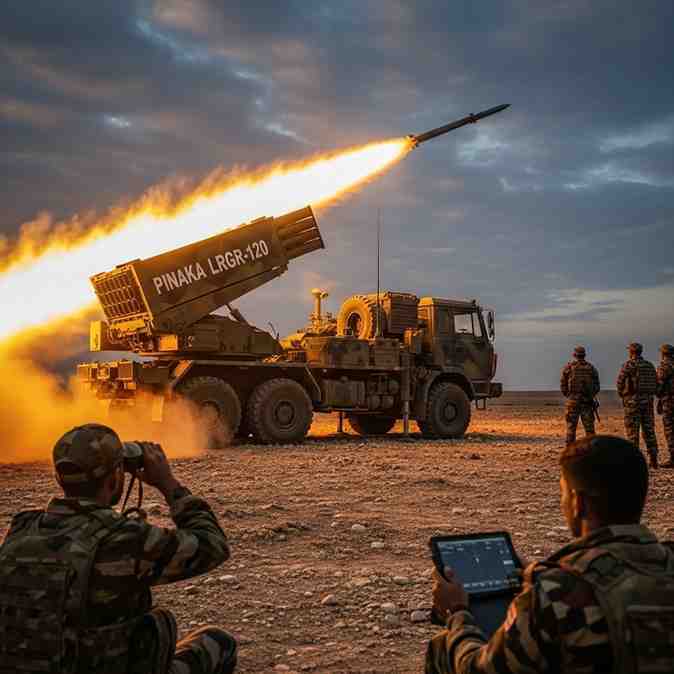
India’s successful maiden flight test of the 120-km Pinaka Long Range Guided Rocket (LRGR-120) marks an important milestone in the country’s quest for credible, indigenous long-range precision strike capability. Conducted at the Integrated Test Range, Chandipur, the trial demonstrated not only extended reach but also high accuracy, manoeuvrability and system reliability—capabilities that modern battlefields increasingly demand. Beyond the technical success, the test reflects a deeper shift in India’s military doctrine, defence industrial capacity, and deterrence posture.
What Was Achieved at Chandipur
On December 30, the Defence Research and Development Organisation (DRDO) successfully carried out the maiden flight trial of the Pinaka LRGR-120. Fired from an in-service Pinaka launcher already deployed with the Indian Army, the rocket accurately hit its designated target at the maximum range of 120 km. Multiple sensors and tracking instruments followed the rocket throughout its flight, validating guidance, navigation and control systems under realistic operational conditions.
Equally important was the validation of planned in-flight manoeuvres. Unlike traditional rockets that follow a purely ballistic path, the LRGR demonstrated mid-course correction, confirming its ability to adapt to dynamic battlefield requirements and maintain accuracy over extended distances.
Evolution of the Pinaka System
The Pinaka system has undergone a remarkable transformation since its induction. Originally conceived as an unguided multi-barrel rocket launcher for area saturation, Pinaka was designed to deliver massive firepower quickly over short to medium ranges. Over time, operational requirements and technological advances pushed the system toward greater precision.
Earlier guided variants with ranges of 60 km and 90 km laid the foundation. The LRGR-120 builds on this evolution, representing the longest-range guided Pinaka rocket tested so far. By incorporating advanced guidance kits and control systems, the LRGR dramatically improves accuracy, reduces ammunition wastage, and enables engagement of high-value targets far beyond the front line.
Operational Significance of Using an In-Service Launcher
A critical operational takeaway from the trial was that the LRGR-120 was fired from an existing Pinaka launcher already in service with the Army. This confirms platform compatibility across multiple rocket variants without major modifications.
For the armed forces, this translates into logistical simplicity, lower induction costs, and faster operational deployment. In high-tempo conflict scenarios, the ability to fire different-range rockets from the same launcher enhances flexibility and responsiveness—key advantages along India’s contested borders.
Indigenous Development and Defence Self-Reliance
The LRGR-120 has been developed by the Armament Research and Development Establishment (ARDE) in collaboration with other DRDO laboratories such as HEMRL, DRDL and RCI. Trial coordination involved the Integrated Test Range and Proof & Experimental Establishment, reflecting a mature ecosystem of indigenous defence research and testing.
This achievement reinforces the credibility of India’s defence R&D institutions. Indigenous development reduces dependence on foreign suppliers, insulates the military from geopolitical disruptions, and allows India to tailor systems to its specific terrain and doctrinal needs.
Pinaka in India’s Military Doctrine
The growing sophistication of the Pinaka system has important doctrinal implications. With guided and extended-range variants, Pinaka now occupies a critical space between conventional tube artillery and tactical missiles. This gives commanders the option of delivering deep, precise strikes without escalating to missile use—an important consideration in limited-conflict or escalation-controlled scenarios.
Such systems enhance deterrence by denial rather than punishment. They complicate adversary planning, threaten rear-area assets, and reduce reliance on more expensive missile systems for targets that can
Month: Current Affairs - December 30, 2025
Category: