Image

Medical Education, PPPs and Public Health: Evaluating Andhra Pradesh’s New Experiment

The Andhra Pradesh government’s proposal to expand medical education through public–private partnerships (PPPs) has ignited a wider debate on the purpose of public policy in health, the future of subsidised medical education, and the risks involved in transferring public health assets to private control. At stake is not merely financing, but the State’s long-term capacity to regulate healthcare delivery, protect equity, and ensure an adequate medical workforce for public service.

Month: 

Category: 

Israel’s Recognition of Somaliland: A Test for Sovereignty, Secession and Regional Stability

Israel’s decision to formally recognise Somaliland as an independent state marks a significant rupture in long-standing international consensus and has triggered diplomatic shockwaves across Africa and the Middle East. While recognition may appear symbolic, its implications are deeply geopolitical, raising questions about sovereignty, regional balance, and the future norms governing secession in the international system—particularly in fragile regions like the Horn of Africa.

Month: 

Category: 

Free Food or Direct Income Support? Rethinking India’s Food Security Model

India’s food security programme is often celebrated as a triumph of scale. Under the National Food Security Act (NFSA), more than 800 million people receive free rice and wheat, making it one of the largest welfare interventions in the world. Yet behind this achievement lies a sobering fiscal and administrative reality: foodgrains are never truly free. As India rethinks welfare delivery for the next phase of development, a fundamental question arises — is distributing grain the most effective way to ensure food security, or would direct income support deliver better outcomes?

Month: 

Category: 

Tax Cuts or Targeted Spending? Rethinking Growth Strategy in India

Few economic ideas have travelled as widely—and contentiously—as the Laffer Curve. Popularised during the era of supply-side economics, the argument that lower taxes can stimulate growth and ultimately raise revenues has influenced policymaking across countries and decades. In contemporary India, echoes of this thinking are visible in recent income tax relief measures and GST rate rationalisation. Yet, evidence from household behaviour, labour markets and past policy experiments suggests that tax cuts alone are an uncertain instrument for reviving growth—especially in an economy where demand recovery and job creation remain uneven.

Month: 

Category: 

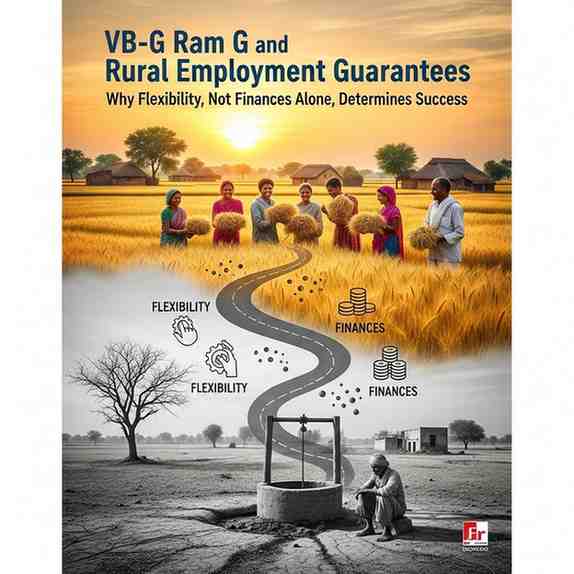
VB-G Ram G and Rural Employment Guarantees: Why Flexibility, Not Finances Alone, Determines Success

The passage of the Viksit Bharat Guarantee for Rojgar and Ajeevika Mission (VB-G Ram G) Bill has reignited a long-standing debate around India’s rural employment guarantee framework. Two provisions have attracted particular criticism: permitting States to pause work for up to 60 days during peak agricultural seasons, and revising the funding ratio to 60:40 between the Centre and States. Critics argue that these changes dilute the original spirit of the Mahatma Gandhi National Rural Employment Guarantee Act (MGNREGA), especially for poorer States. However, empirical evidence suggests that the effectiveness of rural employment guarantees depends less on fiscal capacity alone and more on governance quality, labour-market conditions and local economic structures.

Month: 

Category: