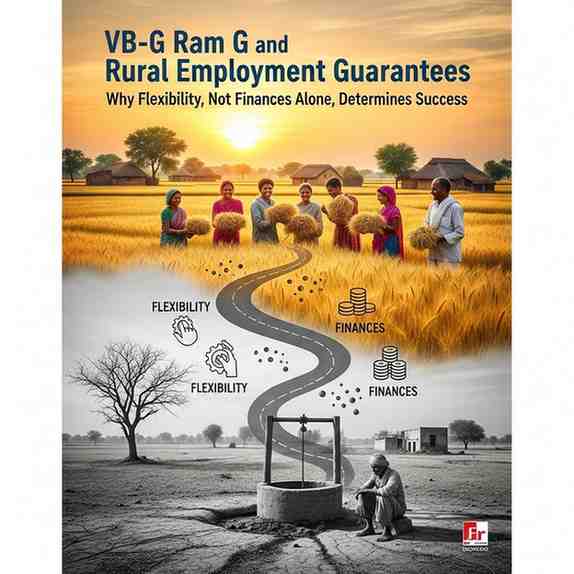
The passage of the Viksit Bharat Guarantee for Rojgar and Ajeevika Mission (VB-G Ram G) Bill has reignited a long-standing debate around India’s rural employment guarantee framework. Two provisions have attracted particular criticism: permitting States to pause work for up to 60 days during peak agricultural seasons, and revising the funding ratio to 60:40 between the Centre and States. Critics argue that these changes dilute the original spirit of the Mahatma Gandhi National Rural Employment Guarantee Act (MGNREGA), especially for poorer States. However, empirical evidence suggests that the effectiveness of rural employment guarantees depends less on fiscal capacity alone and more on governance quality, labour-market conditions and local economic structures.
The Central Concern: Will Higher State Costs Undermine Guarantees?
Opposition to the revised funding pattern rests on a seemingly intuitive argument: poorer States, which need employment guarantees the most, may struggle to finance a higher share of costs. This, critics warn, could weaken employment security for the rural poor.
Yet, research based on worker-level data compiled by NITI Aayog and published in Regional Statistics complicates this narrative. The study shows that financial capacity alone does not explain variation in outcomes. Instead, implementation quality, local labour demand, corruption levels and economic diversification play decisive roles. A rigid, one-size-fits-all model struggles to accommodate India’s vast inter-State diversity.
What State-Level Evidence Reveals
Drawing on 6,580 worker-level observations across 40 districts and 162 Gram Panchayats in 15 States, the study reveals striking contrasts. Some relatively poorer States, such as Chhattisgarh and Tripura, performed well in delivering employment under MGNREGA. In contrast, States with high poverty incidence like Bihar, Uttar Pradesh and Madhya Pradesh showed weaker utilisation of available funds.
Even within the North-East, outcomes varied sharply. Tripura performed relatively well, while Arunachal Pradesh and Manipur lagged behind. These divergences suggest that poverty levels alone do not determine implementation effectiveness.
Interestingly, richer agricultural States like Punjab and Haryana exhibited low demand for MGNREGA work, coupled with limited administrative enthusiasm for expanding the programme. This indicates that local labour-market dynamics and alternative employment opportunities shape both demand and political commitment.
Wage Effects: Uneven but Insightful
One of MGNREGA’s key objectives has been to exert upward pressure on rural wages. The evidence shows that this effect is uneven across States.
In relatively industrially backward States such as Himachal Pradesh, Jammu and Kashmir, Odisha and West Bengal, workers reported that MGNREGA increased market wages for unskilled labour. In these regions, the programme created genuine labour demand, strengthening workers’ bargaining power beyond MGNREGA worksites.
By contrast, in more industrialised States like Andhra Pradesh, Telangana, Tamil Nadu and Karnataka, the wage effect was muted. Although implementation levels were high, a greater share of expenditure went into machinery-intensive works. Moreover, alternative employment opportunities diluted MGNREGA’s influence on local wage formation.
Industrial Structure Matters More Than Income Levels
A crucial insight from the study is that the degree of industrial and non-farm development matters more than per capita income. Where alternative employment opportunities exist, MGNREGA functions primarily as a fallback option. Where such opportunities are scarce, it becomes a central labour-market anchor.
This helps explain why Karnataka, despite agricultural strength and participation in platforms such as e-NAM, shows relatively low demand for MGNREGA work—labour is already absorbed elsewhere.
Corruption and Political Capture: The Binding Constraints
Month: Current Affairs - December 28, 2025
Category: