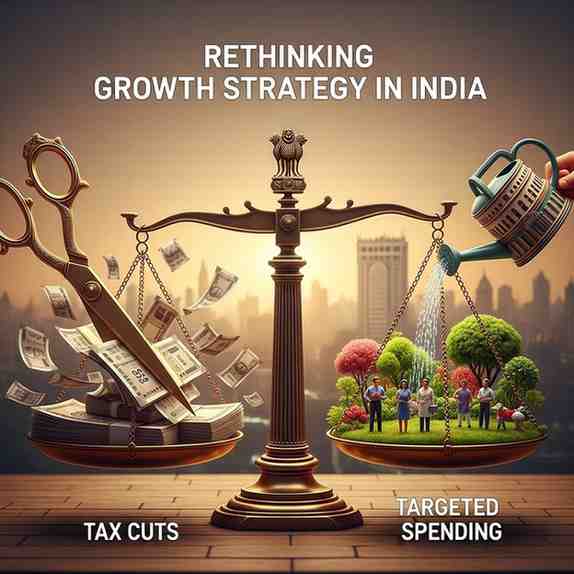
Few economic ideas have travelled as widely—and contentiously—as the Laffer Curve. Popularised during the era of supply-side economics, the argument that lower taxes can stimulate growth and ultimately raise revenues has influenced policymaking across countries and decades. In contemporary India, echoes of this thinking are visible in recent income tax relief measures and GST rate rationalisation. Yet, evidence from household behaviour, labour markets and past policy experiments suggests that tax cuts alone are an uncertain instrument for reviving growth—especially in an economy where demand recovery and job creation remain uneven.
The Economic Logic Behind Tax Cuts
At its core, the case for tax cuts rests on boosting disposable income. Lower taxes are expected to leave households and firms with more money, encouraging consumption and investment. Higher demand, in turn, should lift output and eventually expand the tax base.
This logic underpins two recent policy decisions. Income tax relief is expected to put around ₹1 lakh crore into household hands, while GST rationalisation has led to revenue foregone of nearly ₹48,000 crore. The policy intent is clear: stimulate consumption, especially during peak spending periods, and support economic momentum.
Do Tax Cuts Translate into Higher Consumption?
The impact of tax cuts depends critically on who receives them. Higher-income households, which benefit most from income tax relief, typically have a lower marginal propensity to consume. Additional income for this group is often saved or invested in financial assets rather than spent on goods and services.
Middle- and lower-income households are more price-sensitive, making GST reductions potentially more effective. However, many goods affected—such as automobiles or consumer durables—are purchased infrequently. This often results in short-term demand bunching rather than sustained consumption growth.
For consumption to rise consistently, new consumers must enter the market. That process depends fundamentally on employment generation, not just temporary tax relief.
Why Expenditure Policies Deliver Stronger Demand
India’s recent experience indicates that direct government expenditure has produced more durable consumption effects. The free foodgrain programme covering nearly 800 million people has significantly altered household spending behaviour. When basic food needs are secured, households redirect limited resources toward non-food and discretionary items.
Household consumption surveys reflect this shift, showing declining food expenditure shares and rising non-food spending. This change signals improved welfare rather than distress, as money previously tied to subsistence becomes available for other uses.
Cash Transfers and Targeted Schemes as Demand Drivers
Several government programmes act as direct demand injectors. Schemes such as PM-Kisan, which transfers ₹6,000 annually to farmers, state-level women’s income support programmes, and MGNREGA channel resources toward households with a high propensity to consume.
In-kind transfers—such as bicycles, sewing machines or digital devices—further stimulate demand by directly supporting manufacturing and services. Unlike tax cuts, these measures are tightly targeted, and their impact on consumption is more predictable.
Public Investment and the Multiplier Effect
Among fiscal tools, public capital expenditure stands out as the most potent growth lever. Infrastructure spending generates immediate demand through backward linkages with sectors like steel, cement and construction, while also enhancing long-term productivity by reducing logistics and transaction costs.
This dual impact—short-term stimulus combined with long-term capacity building—makes capital expenditure far more effective than tax cuts in driving sustainable growth.
Lessons from Past Tax Experiments
India’s 2019 corporate tax cut illustrates the limits of supply-side optimism. Despite a significant reduction in rates, private investment did not surge. Firms invest when capacity utilisation is high and demand prospects are strong—not merely because taxes are lower. In a weak demand environment, tax savings were largely retained as profits rather than converted into new investment.
What the Evidence Suggests
From a policy standpoint, a mix of taxation and expenditure tools is sensible. However, the balance of evidence favours expenditure-led strategies. Spending programmes are direct, targeted and aligned with development priorities. Tax cuts rely on behavioural assumptions that vary widely across income groups and economic conditions.
Why Targeting Matters More Than Optics
The choice between tax cuts and spending is not ideological but practical. Expenditure allows governments to identify beneficiaries, anticipate outcomes and link fiscal action to employment, welfare and productivity goals. Tax cuts provide visibility and short-term relief but offer uncertain growth dividends unless supported by job creation and sustained demand.
Conclusion
In an economy where consumption recovery remains fragile, growth is driven less by what the government forgoes in taxes and more by where—and on whom—it spends. India’s development challenge calls for policies that prioritise targeted expenditure, employment generation and public investment over reliance on tax cuts as a standalone growth strategy.
Month: Current Affairs - Dec 28, 2025
Category: