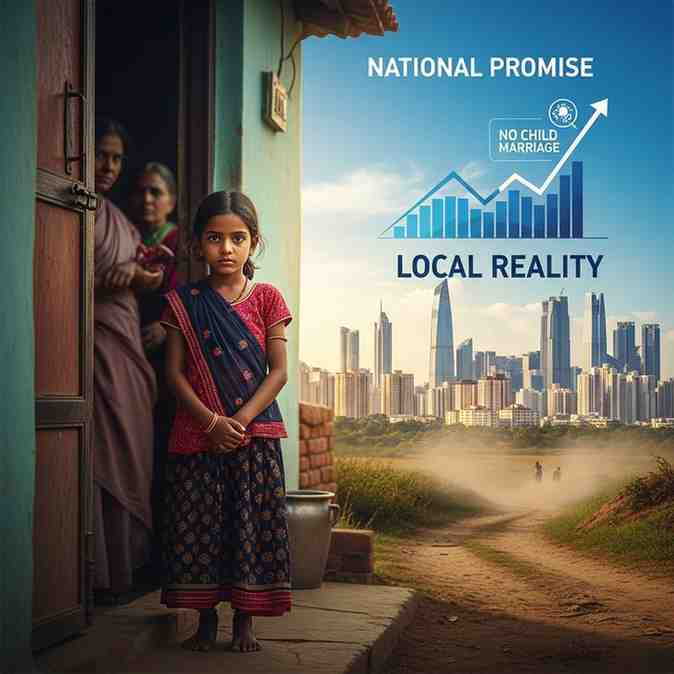
India has committed itself to an ambitious and morally compelling goal: ending child marriage by 2030 under the United Nations Sustainable Development Goals. On paper, the country appears to be moving in the right direction. Official data shows a steady decline in the prevalence of child marriage over the past two decades. Yet beneath this encouraging national trend lies a stubborn reality — the practice remains deeply entrenched in specific regions, communities, and socio-economic groups. The persistence of child marriage exposes a critical gap between policy intent and lived experience, raising questions about enforcement, social norms, and the limits of law-driven reform.
Progress Made: A Declining National Trend
India’s efforts against child marriage have yielded measurable gains. According to the National Family Health Survey (NFHS), the share of women aged 20–24 who were married before the age of 18 declined from nearly half in 2005–06 to just over one-fifth by 2019–21. This improvement reflects multiple positive developments: expanded access to schooling, better maternal health awareness, declining fertility norms, and targeted government schemes aimed at girls’ welfare.
The Union government’s launch of the Bal Vivah Mukt Bharat Abhiyan , accompanied by nationwide awareness campaigns, signals renewed political commitment. These initiatives acknowledge that legal prohibition alone is insufficient and that sustained public engagement is necessary to change entrenched practices.
Uneven Geography of Child Marriage
Despite national progress, child marriage in India remains highly uneven across States. Prevalence is particularly high in parts of eastern and central India, including West Bengal, Bihar, Jharkhand, and Tripura, as well as in States such as Rajasthan, Madhya Pradesh, Assam, Telangana, and Andhra Pradesh.
This unevenness highlights a crucial truth: national laws and schemes operate within local social ecosystems. Poverty levels, gender norms, caste hierarchies, administrative capacity, and political priorities vary sharply across States. Where governance is weaker and social norms favour early marriage, national policies struggle to gain traction.
Poverty, Education and the Marriage Decision
Data consistently shows that child marriage is closely linked to economic vulnerability and lack of education. Girls from the poorest households are several times more likely to be married early than those from affluent families. Education, in particular, emerges as the strongest protective factor. Girls with higher education face an extremely low risk of child marriage compared to those with no schooling.
For families living on the edge of survival, early marriage is often perceived as a rational coping strategy — reducing household expenses, ensuring social “security” for daughters, and conforming to community expectations. This logic, while harmful, cannot be dismantled through legal threats alone.
Laws on Paper, Weak Enforcement on the Ground
India has a strong legal framework in the form of the Prevention of Child Marriage Act, 2006 , which criminalises the practice and empowers officials to intervene. However, enforcement remains sporadic. Convictions are rare, reporting is low, and local authorities often hesitate to act against families due to social pressure and fear of backlash.
The use of stricter laws such as the POCSO Act has introduced additional complexities. Its blanket criminalisation of underage sexual activity leaves little room for nuance in cases of consensual adolescent relationships. This has sometimes resulted in unintended consequences, discouraging girls from approaching healthcare providers or legal authorities, and pushing them into unsafe alternatives.
Health Risks and Policy Paradoxes
Child marriage is strongly associated with adverse health outcomes
Month: Current Affairs - December 29, 2025
Category: