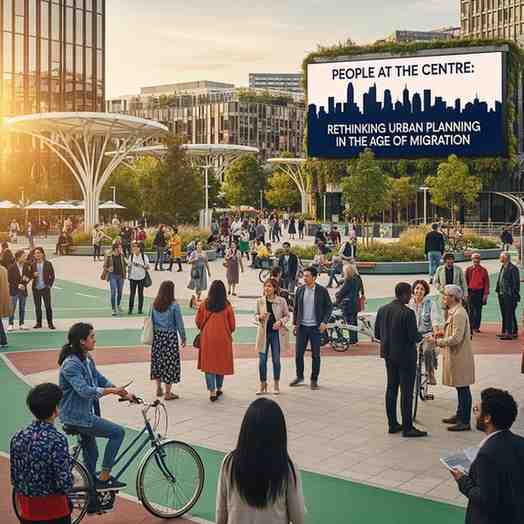
Cities today dominate the global imagination as engines of growth, innovation, and opportunity. From smart infrastructure to digital governance, urban policy often focuses on efficiency, scale, and competitiveness. Yet, in this pursuit, the most fundamental element of urban life is frequently overlooked—the people who inhabit cities, migrate to them, and continually reshape them. The widening gap between how cities are designed, how they are imagined, and how they are actually experienced points to a critical missing link in modern urban planning.
The Invisible Cost of Urban “Belonging”
Migration to cities often comes with an unspoken expectation of assimilation. Language becomes the first and most rigid marker of belonging. Those who cannot speak the dominant language fluently face what may be termed an “invisible tax”—a constant social and psychological cost imposed not through law, but through everyday interactions.
This tax is not merely communicative. Language functions as a gateway to legitimacy, dignity, and acceptance. In cities that are inherently multilingual and culturally layered, enforcing linguistic uniformity reflects deeper anxieties about identity and ownership. For new residents, belonging remains conditional, negotiated daily through subtle exclusions and reminders of difference.
From Linguistic Barriers to Economic Marginalisation
Linguistic exclusion quickly translates into economic disadvantage. Access to employment, housing, healthcare, and public services is often mediated through monolingual bureaucratic systems. For migrants unfamiliar with the dominant language, routine interactions become complex obstacles.
As a result, many are pushed into the informal economy—characterised by low wages, limited security, and high vulnerability. Paradoxically, cities rely heavily on this labour for construction, sanitation, care work, and service delivery. Urban prosperity is thus built on a workforce that remains structurally excluded from the full benefits of city life. Exclusion, in this context, is not incidental but systematically produced.
The Flawed Assumption in Urban Planning
At the core of this problem lies a flawed planning assumption: that the “urban user” is static, familiar with existing systems, and culturally aligned with dominant norms. Planning frameworks often cater to established residents, rendering new arrivals largely invisible despite their growing numbers.
Even contemporary initiatives such as smart cities risk reinforcing this bias. Digital platforms, automated services, and data-driven governance tend to privilege those with digital literacy, formal documentation, and linguistic competence. Instead of expanding access, “smart” solutions can unintentionally deepen exclusion.
Governance That Fails to Mirror Urban Diversity
Urban governance structures frequently lag behind demographic realities. Local decision-making bodies and planning committees often lack representation from migrant or marginalised communities. Consequently, infrastructure planning for transport, education, healthcare, and public spaces fails to account for diverse needs.
New residents may require multilingual interfaces, flexible service hours, or alternative modes of access. When these realities are ignored, urban systems may function efficiently on paper while remaining socially misaligned in practice.
Cities as Dynamic and Living Ecosystems
Cities are not static entities; they are dynamic ecosystems shaped by continuous movement and change. Planning for inclusion requires acknowledging that friction between established systems and new populations is inevitable—and manageable.
Targeted interventions can have transformative effects. Multilingual public communication, cultural sensitisation of frontline staff, and flexible service delivery improve administrative efficiency, reduce social conflict, and strengthen democratic access. Inclusion, therefore, is not an act of charity but an essential component of effective governance.
Empathy as the Missing Link in
Month: Current Affairs - December 28, 2025
Category: