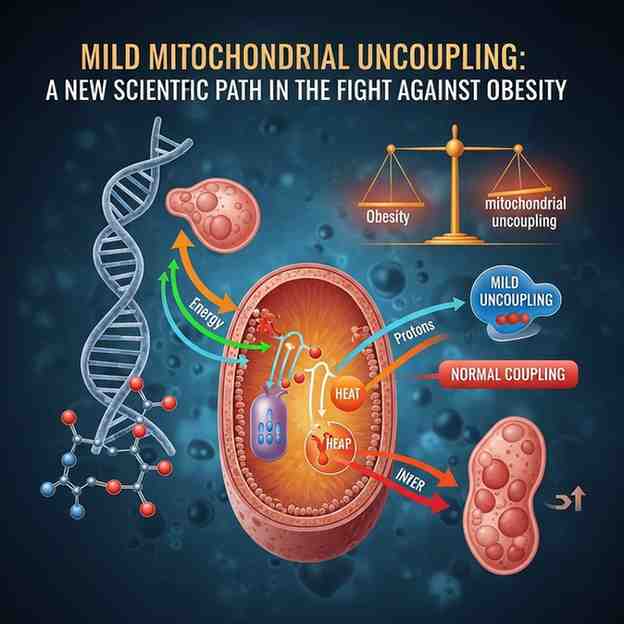
Obesity has emerged as one of the most complex public health challenges of the 21st century, driving diabetes, cardiovascular disease, and metabolic disorders worldwide. While most treatments focus on appetite suppression or lifestyle modification, scientists are now revisiting a bold and once-abandoned biological idea: increasing energy expenditure directly at the cellular level. Recent research from the University of Technology Sydney has renewed interest in this approach by developing safer forms of mitochondrial uncoupling, potentially opening a new frontier in obesity and metabolic disease management.
Mitochondria: The Core of Cellular Energy Balance
Mitochondria are essential cellular organelles responsible for converting nutrients into adenosine triphosphate (ATP), the molecule that powers nearly all biological functions. This process links food intake with energy availability, determining how efficiently the body uses calories.
In obesity, this balance is disrupted. Energy intake consistently exceeds energy expenditure, leading to fat accumulation and metabolic stress. Targeting mitochondria therefore offers a direct way to address obesity at its biological root—how cells handle energy—rather than focusing solely on behaviour or appetite.
The Scientific Logic of Mitochondrial Uncoupling
Under normal conditions, mitochondria tightly “couple” nutrient breakdown with ATP production. Mitochondrial uncoupling deliberately disrupts this process. Instead of converting all energy into ATP, cells release part of it as heat.
This forces the body to burn more fats and carbohydrates to maintain energy needs. In effect, metabolic efficiency is reduced in a controlled manner, increasing calorie consumption at rest. Such an approach shifts obesity treatment from reducing intake to increasing expenditure.
Why Early Uncouplers Failed
Although mitochondrial uncoupling was discovered nearly a century ago, early compounds proved extremely dangerous. These agents caused uncontrolled heat production, leading to hyperthermia, organ failure, and death.
The core problem was lack of control. Once administered, the drugs pushed mitochondria beyond safe limits, leaving no mechanism to regulate the intensity of energy burning. Consequently, uncouplers were categorised as toxic substances rather than therapeutic tools.
What Makes the New Approach Safer
The recent breakthrough lies in precision. Researchers have engineered “mild” mitochondrial uncouplers that subtly reduce energy efficiency without overwhelming cellular systems.
By carefully modifying molecular structures, scientists achieved controlled uncoupling—enough to increase fuel consumption and heat generation, but not enough to cause toxicity. This fine balance distinguishes modern compounds from earlier lethal versions and explains their improved safety profile in experimental settings.
Benefits Beyond Weight Reduction
An important and unexpected finding is that mild uncoupling reduces oxidative stress within cells. Oxidative stress is a key contributor to ageing, insulin resistance, and neurodegenerative disorders.
By lowering this stress, mitochondrial uncouplers may improve overall metabolic health, enhance insulin sensitivity, and potentially protect against age-related cognitive decline. This broadens their relevance beyond obesity, positioning them as possible interventions for multiple chronic diseases.
Current Status and Future Challenges
Despite promising laboratory results, the research remains in an early stage. Extensive animal studies, clinical trials, and long-term safety evaluations are required before any human use.
Key challenges include:
-
Ensuring precise dose control
-
Preventing unintended heat accumulation
Month: Current Affairs - December 28, 2025
Category: