services during prolonged disputes.
Long-term leases also constrain policy flexibility. As healthcare delivery evolves—with stronger primary care, shorter hospital stays and more day-care procedures—the relevance of uniform 650-bed hospitals across districts may diminish.
Implications for Public Health and Workforce Availability
Andhra Pradesh already faces shortages of doctors and specialists, especially in rural areas. Commercialising medical education could worsen this imbalance, as high-fee graduates are more likely to pursue urban private practice or migrate abroad.
Instead of selling seats at market rates, many experts argue for expanding subsidised education tied to compulsory public service, which would directly strengthen district-level healthcare capacity.
Beyond Fiscal Constraints: A Question of Governance
Supporters of PPPs cite fiscal stress, but critics note that States have alternative borrowing and financing mechanisms that do not require relinquishing control over public hospitals. Privatisation demands strong regulatory capacity, yet India’s experience in enforcing even basic health regulations has been uneven.
Past experiments with contracted primary healthcare services have exposed weaknesses in monitoring and accountability. In such an environment, transferring strategic public health assets to private hands carries significant equity and governance risks.
A Broader Crisis in Medical Education Quality
India’s medical education system is already strained, with rapid expansion outpacing the availability of qualified faculty. Observers warn that unchecked growth could mirror the decline seen in engineering education, where quantity expanded at the cost of quality.
The central issue, therefore, is not the number of medical colleges, but whether standards, accessibility and public health objectives are preserved.
Conclusion
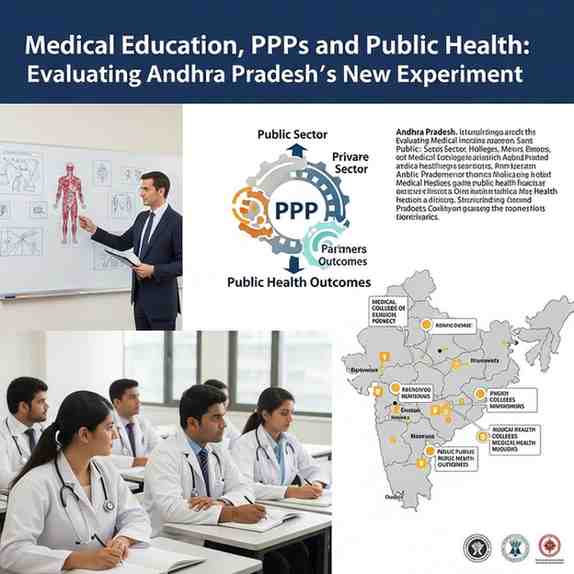
The Andhra Pradesh PPP proposal raises fundamental questions about the role of the State in health and education. While expanding medical capacity is essential, doing so by diluting public control over district hospitals and medical education may undermine long-term health outcomes.
Medical education is not merely a commercial investment; it is a strategic public good. Any reform must prioritise equity, accountability and workforce availability over short-term fiscal convenience. Without strong regulation and clear public interest safeguards, the current PPP model risks weakening, rather than strengthening, Andhra Pradesh’s public health system.
Month: Current Affairs - December 29, 2025
Category: