Perhaps the most serious challenge identified is corruption. In several poorer States, workers reported denial of work, delayed or missing payments, and manipulation of records. Practices such as fake job cards, ghost beneficiaries, asset misappropriation and verbal work allocations undermine trust in the programme.
In extreme cases, workers stopped demanding employment altogether, believing that requests would be futile or unpaid. Evidence from States like Kerala and West Bengal also points to political interference, where local bodies allegedly channelled benefits toward party workers. Such distortions reduce participation and erode the programme’s wage and employment effects.
The Case for Regional Customisation
These findings underscore a fundamental reality: diversity across States is structural, not incidental. Labour markets, cropping patterns, industrial bases and governance capacities vary widely. Uniform implementation may appear equitable, but it often proves inefficient.
India already acknowledges such diversity through its classification into 88 agro-climatic regions. Aligning employment guarantees like VB-G Ram G with regional characteristics—seasonality, occupational patterns and labour demand—would improve effectiveness.
Reframing the VB-G Ram G Debate
Allowing States flexibility, including pausing work during peak agricultural seasons, need not weaken employment guarantees if safeguards are strong. The real threats lie in poor governance, weak monitoring and political capture.
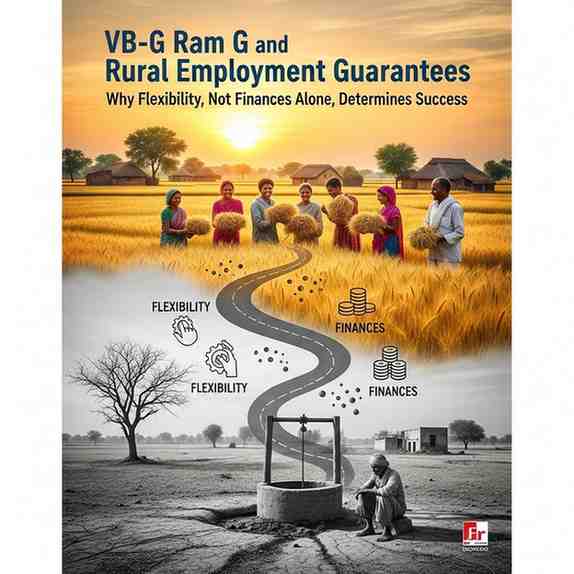
For VB-G Ram G to succeed, flexibility must be paired with transparency, accountability and region-specific design. Treating unequal contexts identically risks reproducing failures rather than preventing them.
Conclusion
The evidence suggests that rural employment guarantees work best not when they are rigidly uniform, but when they are locally grounded, corruption-resistant and aligned with economic realities. Financial capacity matters, but governance quality matters more. The VB-G Ram G debate should therefore move beyond funding ratios and focus on how flexibility, accountability and regional customisation can strengthen — rather than dilute — India’s commitment to rural livelihood security.
Month: Current Affairs - December 28, 2025
Category: