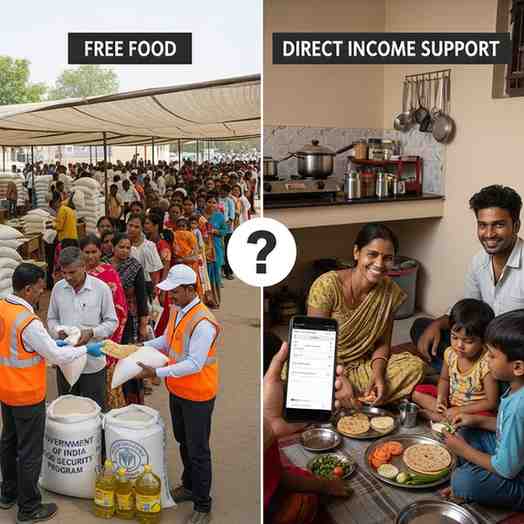
India’s food security programme is often celebrated as a triumph of scale. Under the National Food Security Act (NFSA), more than 800 million people receive free rice and wheat, making it one of the largest welfare interventions in the world. Yet behind this achievement lies a sobering fiscal and administrative reality: foodgrains are never truly free. As India rethinks welfare delivery for the next phase of development, a fundamental question arises — is distributing grain the most effective way to ensure food security, or would direct income support deliver better outcomes?
The True Cost of “Free” Foodgrains
The fiscal burden of food distribution is far higher than the issue price suggests. Once procurement, storage, transportation, interest costs and handling losses are accounted for, the economic cost borne by the State ranges between ₹28 and ₹40 per kilogram. In FY 2024–25, the Food Corporation of India estimated this cost at ₹39.75 per kg for rice and ₹27.74 per kg for wheat.
As a result, the food subsidy bill stood at roughly ₹2.05 lakh crore. This represents a significant share of public expenditure — and yet, high spending does not necessarily translate into efficient or equitable delivery.
Leakages, Losses and Logistics Constraints
Structural inefficiencies plague the Public Distribution System (PDS). Multiple studies suggest that nearly 28% of subsidised foodgrains fail to reach intended beneficiaries. Around 20 million tonnes are diverted or lost annually, imposing a fiscal cost of over ₹69,000 crore when valued at government economic cost.
Logistics further compound the problem. India’s logistics expenditure is estimated at nearly 8% of GDP, and the PDS contributes substantially to storage and transport costs. Quality deterioration is another concern. Between 2011 and 2017, over 62,000 tonnes of foodgrains reportedly rotted in FCI warehouses, often stored in outdated facilities or under temporary covers.
A Disruptive but Necessary Question
If the government already pays the full economic cost of foodgrains, why not transfer that value directly to households? Why maintain a capital-intensive, leakage-prone supply chain when the ultimate objective is consumption support?
This question does not imply rolling back welfare. Instead, it opens the door to delivering welfare more efficiently through direct income support.
How Direct Benefit Transfer Can Ensure Food Security
Under a Direct Benefit Transfer (DBT) model, beneficiaries would receive a monthly cash transfer equivalent to the true economic cost of their NFSA entitlement — roughly ₹28–₹40 per kg — directly into Aadhaar-linked bank accounts. Transfers could be indexed to cereal inflation to preserve purchasing power.
India already possesses the technological backbone for such an approach. DBT platforms successfully deliver LPG subsidies, PM-KISAN payments, pensions and scholarships at national scale. The shift would convert a supply-side subsidy into a transparent, demand-side intervention.
Evidence from States: Lessons from Karnataka
Concerns that cash transfers may undermine food security are valid, but empirical evidence is encouraging. Karnataka’s Anna Bhagya scheme, which provided cash in lieu of grain, found that beneficiaries often used transfers to purchase better-quality cereals and diversify diets.
The scheme also promoted financial inclusion by encouraging bank account usage. Rather than weakening food security, income support enhanced household choice, dignity and nutritional outcomes.
Why Transition Must Be Gradual and Voluntary
A nationwide shift cannot be abrupt.
Month: Current Affairs - December 28, 2025
Category: