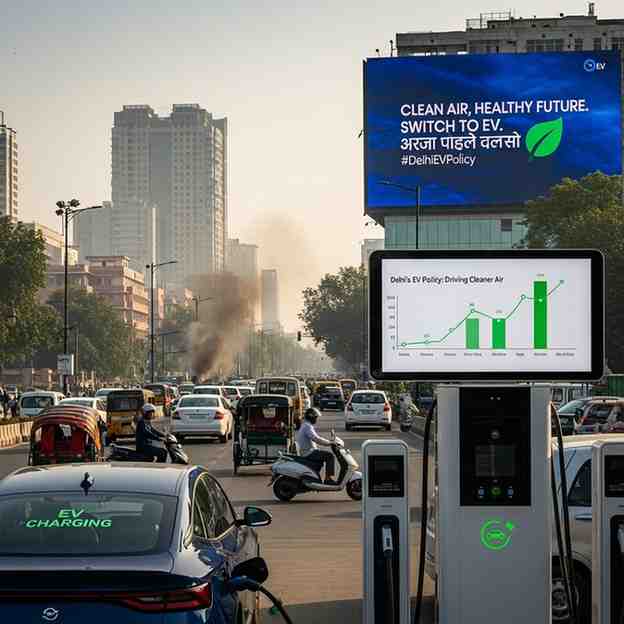
The Delhi government’s decision to introduce a revamped electric vehicle (EV) policy next year reflects both progress in clean mobility and a growing recognition of its limitations. Five years after launching one of India’s most ambitious EV policies, Delhi has learnt a crucial lesson: increasing the number of electric vehicles does not automatically translate into cleaner air. Without removing the most polluting vehicles, enforcing scrappage norms, and coordinating regionally, EV adoption alone cannot resolve the city’s air pollution crisis.
What the First EV Policy Achieved
Delhi’s 2020 EV policy set an ambitious target of 25% electric vehicles in new registrations by 2024. While this goal was not met, the policy did succeed in accelerating EV adoption. Today, EVs account for just over 12% of new vehicle registrations—among the highest shares in the country.
The city also expanded charging infrastructure, waived road tax and registration fees, and provided purchase subsidies, particularly for two- and three-wheelers. These measures helped mainstream EVs and established Delhi as a national leader in clean mobility adoption.
Why EV Growth Did Not Improve Air Quality
Despite higher EV numbers, Delhi’s winter smog remains as severe as ever. The reason lies in the composition of the city’s vehicle fleet. Most EV adoption has occurred in two- and three-wheelers, which already have relatively low emissions per vehicle.
Meanwhile, the most polluting vehicles—old diesel trucks, buses, and cars—continue to operate. Data submitted to the Commission for Air Quality Management shows that nearly 37% of vehicles in the Delhi–NCR still run on BS-III or older engines. These vehicles emit disproportionately high levels of particulate matter and nitrogen oxides, especially during winter temperature inversions.
As a result, EVs have largely been added to the transport system without displacing the dirtiest vehicles, limiting their impact on overall air quality.
The Scrappage Gap and Judicial Intervention
Weak enforcement of end-of-life vehicle norms has been a major failure. This prompted intervention by the Supreme Court of India, which recently lifted its ban on the Delhi government after clarifying that only BS-IV and newer vehicles would be exempt from action.
The Court’s clarification narrowed ambiguities created by earlier age-based rules for petrol and diesel vehicles. Evidence showed that BS-II and BS-III vehicles—typically older than 10 years for diesel and 15 years for petrol—are among the largest contributors to Delhi’s winter pollution. Without strict and sustained scrappage enforcement, EV adoption alone cannot deliver clean-air outcomes.
What the Revamped EV Policy Seeks to Do
The forthcoming EV policy signals a shift from subsidy-centric design to a more systemic approach. Key proposals include:
-
Linking EV purchase incentives to the scrapping of old vehicles
-
Expanding neighbourhood-level charging infrastructure
-
Continuing waivers on road tax and registration fees
-
Supporting battery-swapping models to reduce upfront costs
By tying incentives to vehicle retirement, the policy aims to ensure that clean vehicles replace polluting ones, rather than simply increasing total vehicle numbers.
Delhi’s Structural Constraint: A Shared Air Basin
Delhi’s air pollution problem cannot be solved within city boundaries alone.
Month: Current Affairs - December 28, 2025
Category: