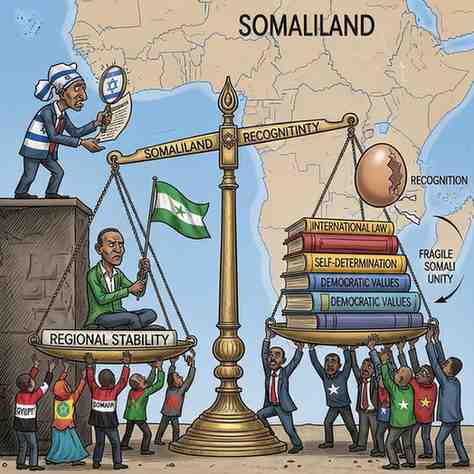
Israel’s decision to formally recognise Somaliland as an independent state marks a significant rupture in long-standing international consensus and has triggered diplomatic shockwaves across Africa and the Middle East. While recognition may appear symbolic, its implications are deeply geopolitical, raising questions about sovereignty, regional balance, and the future norms governing secession in the international system—particularly in fragile regions like the Horn of Africa.
Somaliland: De Facto State, De Jure Dispute
Somaliland is a self-declared republic in northwestern Somalia, centred around its capital, Hargeisa. It emerged in 1991 following the collapse of Somalia’s central government and a violent civil war. Since then, Somaliland has operated with its own elected government, currency, security apparatus and relatively stable institutions.
Despite these features of statehood, Somaliland remained unrecognised internationally until Israel’s move. The global community has consistently upheld Somalia’s territorial integrity, guided by fears that recognising breakaway regions could encourage fragmentation across Africa, where colonial borders remain politically sensitive.
Somalia’s federal government has rejected Somaliland’s claim to independence but lacks the capacity—political or military—to reassert control, leaving the dispute unresolved but frozen.
Why Israel’s Move Is a Diplomatic Break
Israel’s recognition breaks with decades of international restraint on Somalia’s unity. It immediately drew condemnation from Somalia and several regional powers, including Egypt, Turkey and Djibouti, all of whom reaffirmed support for Somalia’s sovereignty.
For these states, the concern is not confined to Somalia alone. The broader fear is precedent. Recognising Somaliland risks legitimising unilateral secession elsewhere—whether in Africa, the Middle East or beyond—undermining a core principle of international order: territorial integrity.
This explains why the backlash has been swift and unusually coordinated.
A Fragile Horn of Africa
The Horn of Africa is already one of the world’s most volatile regions. Somalia continues to face insurgency from al-Shabaab. Ethiopia is grappling with internal ethnic conflicts and tense relations with neighbours. Disputes over port access and maritime routes have further heightened regional tensions.
In this context, recognition of Somaliland alters the strategic calculus. A newly recognised Somaliland could pursue defence partnerships, invite foreign military presence, or seek greater autonomy over ports along the Gulf of Aden—moves that neighbouring states may view as destabilising.
Rather than resolving a long-standing dispute, recognition risks adding a new fault line to an already fractured region.
Abraham Accords and Middle East Spillovers
The controversy is further intensified by reports that Somaliland has expressed interest in joining the Abraham Accords—the framework normalising relations between Israel and several Arab states.
For countries like Egypt and Turkey, this raises alarms about Israel extending its diplomatic and strategic footprint into the Horn of Africa, particularly near vital Red Sea and Gulf of Aden trade routes. These waterways are central to global commerce and regional security, making any shift in influence deeply consequential.
Thus, opposition to Israel’s move reflects broader anxieties about changing power dynamics, not just Somalia’s internal borders.
The United States: Strategic Ambiguity
The United States has so far adopted a cautious stance. President Donald Trump publicly stated that Washington would “study” the issue, stopping short of endorsing Israel’s decision.
This ambiguity reflects competing US priorities: maintaining close ties
Month: Current Affairs - December 28, 2025
Category: