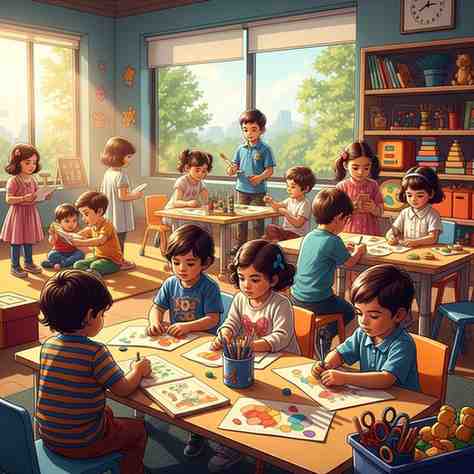
When India visualises itself in 2047, the centenary year of Independence, the image is often dominated by world-class infrastructure, digital connectivity and a multi-trillion-dollar economy. Yet, the true foundation of a developed India will not be laid only through highways or high-speed rail. It will be shaped by the children being born today, who will enter adulthood in 2047. How India invests in the first six years of their lives will largely determine whether the vision of Viksit Bharat is realised.
Why the First Six Years Are Decisive
Scientific evidence is unequivocal: nearly 85% of brain development occurs before the age of six. These formative years shape cognitive ability, emotional regulation, social behaviour and learning capacity throughout life. Economic research reinforces this finding, showing that investment in early childhood development delivers among the highest returns of any public spending, through improved productivity, higher lifetime earnings and reduced social costs.
Beyond economic logic lies an ethical imperative. A child’s future should not be predetermined by parental income or place of birth. Yet, without quality early care and learning, inequality becomes entrenched even before formal schooling begins.
India’s Underappreciated Asset: The Anganwadi System
India possesses a rare advantage in the form of the Integrated Child Development Services (ICDS) network. Over five decades, the country has built one of the world’s largest early childhood systems, powered by nearly 25 lakh anganwadi workers and helpers serving more than 10 crore mothers and children.
Despite its scale, anganwadis are often seen narrowly as nutrition centres. While nutrition remains vital, early childhood development requires much more. As household incomes rise and female workforce participation increases, families increasingly seek safe, full-day spaces where children can learn and grow while parents work with confidence.
The Hidden Cost of Inadequate Early Learning
The consequences of neglecting early education are already visible. Nearly one crore children aged three to six remain outside any organised early learning system. Many enter primary school without basic literacy or numeracy skills, placing them at a long-term disadvantage.
Once these gaps emerge, remediation becomes expensive and only partially effective. This undermines not only individual potential but also the broader goal of building a skilled and productive workforce for a modern economy.
Transforming Anganwadis into ‘Bhavishya Bhavans’
India does not need a new institutional framework; it needs to reimagine the one it already has. A National Mission on Early Childhood Development, Care and Education (ECDCE) could transform anganwadis into full-day learning and care centres — Bhavishya Bhavans , or builders of the future.
Under such a mission, anganwadis would function for extended hours, offering safe childcare alongside structured, play-based learning. Anganwadi workers would be professionally trained and recognised as early childhood educators, supported by better remuneration, career pathways and modern pedagogical tools. The focus would shift from survival alone to holistic development — cognitive, emotional, social and physical.
Evidence That Reform Is Feasible
This vision is already taking shape in parts of India. States like Telangana have piloted extended-hour anganwadi models with positive outcomes. At the national level, initiatives such as Poshan Bhi Padhai Bhi and play-based curricula like Navchetana and Aadharshila signal a policy shift towards integrated development.
These efforts demonstrate that reform is not only desirable but also scalable, provided it is backed by sustained
Month: Current Affairs - December 28, 2025
Category: