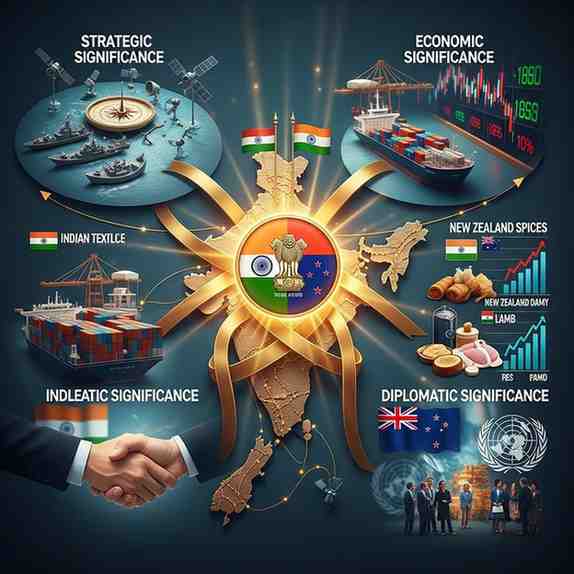
India is poised to conclude 2025 on a high note in economic diplomacy with the successful completion of negotiations for a Free Trade Agreement (FTA) with New Zealand. Announced jointly by Prime Minister Narendra Modi and New Zealand Prime Minister Christopher Luxon, the agreement is expected to significantly deepen bilateral economic ties and potentially double trade volumes within five years. Beyond trade figures, the FTA reflects India’s evolving approach to global economic integration and strategic partnerships.
Key Features of the India–New Zealand FTA
Negotiations for the agreement commenced in March 2025 and were concluded by December the same year, making it one of the fastest trade negotiations undertaken by India. The pact is expected to be formally signed and ratified in the coming months.
The FTA focuses on:
-
Improved market access through tariff reductions on selected goods.
-
Easier entry for Indian exports into New Zealand’s high-income, rules-based market.
-
Enhanced access for Indian consumers and industries to specific New Zealand goods and services.
-
Cooperation in services, investment, and regulatory frameworks.
Leaders from both countries have described the agreement as a historic milestone, underlining growing strategic trust and shared economic interests.
Importance for India’s Trade Policy
India’s trade strategy has undergone a notable transformation in recent years. After withdrawing from the Regional Comprehensive Economic Partnership (RCEP), India has adopted a calibrated bilateral approach—prioritising FTAs that offer measurable benefits while protecting sensitive sectors.
In this context, the New Zealand FTA:
-
Expands export opportunities for Indian sectors such as textiles, pharmaceuticals, engineering goods, IT services and processed foods.
-
Reduces non-tariff barriers, helping Indian firms compete in a transparent and regulated market.
-
Strengthens India’s presence in the Oceania region, complementing its existing trade agreement with Australia.
-
Positions India as a dependable partner in an era of global supply-chain diversification.
Strategic Gateway to Oceania and the Pacific
While New Zealand’s domestic market is relatively small, its strategic importance lies in its role as a gateway to Oceania and the Pacific Island economies. Preferential access to New Zealand allows Indian firms to:
-
Gain regulatory experience and market credibility.
-
Build export scale and brand recognition.
-
Use New Zealand as a springboard into Australia and other Asia-Pacific markets.
From a geopolitical perspective, enhanced engagement in this region also helps India counterbalance growing Chinese economic influence in the Pacific.
Services, Mobility and Skilled Workforce
A crucial dimension of the FTA is its emphasis on services and workforce mobility. New Zealand faces skill shortages in healthcare, information technology, construction and education—areas where India has a globally competitive talent pool.
Month: Current Affairs - December 28, 2025
Category: Strategic, Economic and Diplomatic