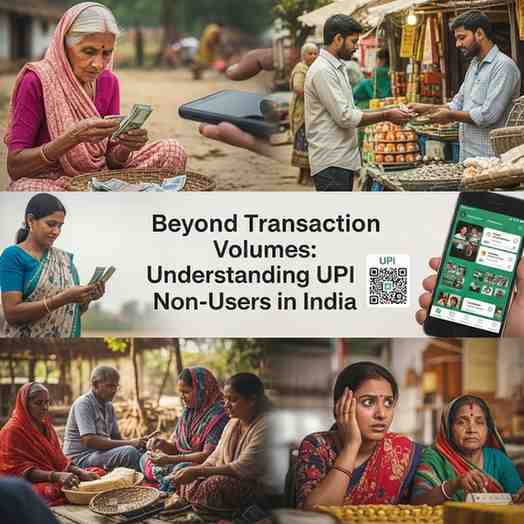
UPI’s Next Challenge: Inclusion Beyond Scale
As the Unified Payments Interface (UPI) approaches a decade of operation, its scale is unprecedented. In November alone, it processed over 20 billion transactions and served nearly 500 million unique users , close to half of India’s addressable population. Yet behind these headline numbers lies a critical policy question: who remains outside the UPI ecosystem, and why?
Growth Story with Data Gaps
UPI has been central to India’s digital public infrastructure (DPI), enabling instant, low-cost payments across merchants and consumers. However, publicly available data remains system-centric, focusing on transaction volumes, values, uptime and failure rates. What is missing is a people-centric picture —granular information on adoption across regions, income groups, age, or gender. Without this, inclusion gaps remain largely invisible.
Why Non-Users Matter Now
UPI’s early expansion rode on Jan Dhan bank accounts, smartphone growth and aggressive merchant onboarding. Future growth, however, depends on reaching harder-to-include groups. Aggregate success can mask persistent exclusion, leading to blunt policy tools instead of targeted solutions.
What Surveys Reveal
A limited survey by Artha Global across districts in Maharashtra and Bihar shows that UPI non-users are not a single group. Instead, they fall into three broad categories:
-
The Unaware: Around 57% of non-users had never heard of UPI, highlighting persistent information gaps even in relatively advanced states.
-
Aware but Access-Constrained: Many know about UPI but lack smartphones, reliable internet, or digital confidence. These barriers are often gendered , with women less likely to own devices.
-
Access-Ready but Unconvinced: This group has smartphones and bank accounts but avoids UPI due to usability issues, fear of fraud, or lack of trust.
The Case for a National Baseline Study
These findings point to the need for differentiated interventions —awareness campaigns, device access and digital literacy, or better consumer protection and interface design. A national baseline study mapping UPI users and non-users would allow precision policymaking and long-term tracking.
Exam-Focused Points
-
UPI is a core component of India’s Digital Public Infrastructure (DPI)
-
Aggregate transaction data does not capture inclusion gaps
-
Digital exclusion can stem from awareness, access, or trust issues
-
Gendered access to smartphones affects digital adoption
Month: Current Affairs - December 26, 2025
Category: Economy, Digital India