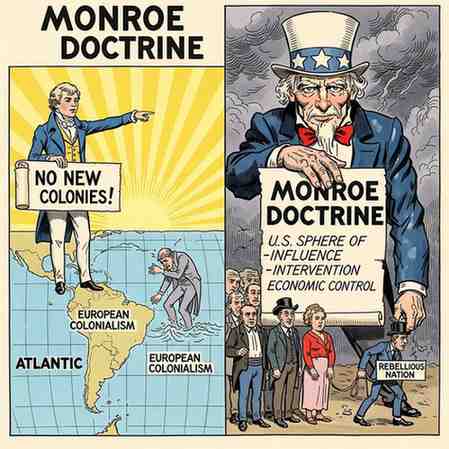
When U.S. President Donald Trump invoked the Monroe Doctrine to justify the capture of Venezuelan leader Nicolás Maduro , he revived one of the oldest and most contentious ideas in American foreign policy. First articulated more than two centuries ago, the doctrine has never been static. Instead, it has evolved alongside U.S. power, repeatedly reinterpreted to legitimise American dominance in the Western Hemisphere. Its latest invocation underscores how historical doctrines can be reshaped to serve contemporary strategic agendas.
Origins of the Monroe Doctrine
The Monroe Doctrine was articulated in 1823 by President James Monroe in his annual message to the U.S. Congress. Its core principle was simple: European powers were warned against further colonisation or political interference in the Western Hemisphere. In return, the United States pledged non-interference in European wars and internal affairs.
At the time, the doctrine reflected both idealism and ambition. Much of Latin America had recently gained independence from Spanish and Portuguese rule, and the doctrine positioned the U.S. as a guardian against renewed European imperialism. Yet it also asserted, implicitly, that the Americas lay within a distinct U.S. sphere of influence. Initially, the doctrine carried limited practical force, as American military power was modest and Britain’s navy did most of the actual deterrence.
From principle to power projection
As U.S. power expanded in the late nineteenth century, the Monroe Doctrine transformed from a warning into a tool of enforcement. Its decisive reinterpretation came in 1904 under President Theodore Roosevelt through the Roosevelt Corollary. This asserted that the United States had not only the right but the responsibility to intervene in Latin American states deemed unstable or incapable of managing their affairs.
This shift fundamentally altered the doctrine’s character. No longer a shield against European imperialism, it became a justification for American intervention. The corollary underpinned U.S. involvement in Panama’s secession from Colombia, control over the Panama Canal Zone, and repeated military interventions across the Caribbean and Central America. Stability, as defined by Washington, became the standard by which sovereignty could be suspended.
The Cold War reinterpretation
During the Cold War, the Monroe Doctrine was reframed once again, this time as an anti-communist instrument. The United States invoked hemispheric security to block Soviet influence, most dramatically during the Cuban Missile Crisis of 1962. The doctrine also provided ideological cover for U.S. actions against leftist governments and movements, from Cuba and Nicaragua to Chile.
In this phase, the doctrine’s emphasis shifted from territorial non-colonisation to ideological exclusion. Any alignment with America’s rivals was treated as a violation of hemispheric order. While framed as a defence of freedom, these interventions often undermined democratic processes and entrenched authoritarian regimes, leaving deep scars across Latin America.
Venezuela and the doctrine’s recurring relevance
Venezuela has long occupied a sensitive place in Monroe Doctrine debates. Its vast oil reserves, internal instability, and periodic alignment with U.S. rivals have repeatedly drawn American attention. Under Maduro, Caracas deepened ties with China and Russia, challenging U.S. influence in the region.
Trump cited these alignments, along with allegations of narcotics trafficking and migration pressures, as evidence that Venezuela posed a direct threat to U.S. security. By framing Maduro’s capture as consistent with the Monroe Doctrine, Trump linked a contemporary coercive action to a centuries-old policy tradition, presenting it as continuity rather than rupture.
The “Trump Corollary” and revived hemispheric dominance
Month: Current Affairs - January 06, 2026
Category: