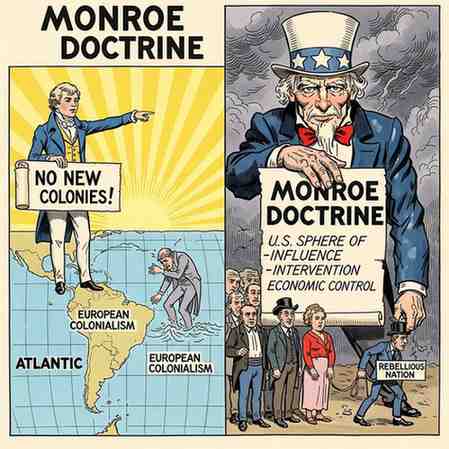
Trump’s rhetoric went beyond historical reference. By jokingly dubbing his approach the “Don-roe Doctrine,” he echoed a familiar pattern in U.S. history: attaching new strategic agendas to old doctrines to confer legitimacy. His administration’s national security documents spoke openly of restoring American primacy in the Western Hemisphere, including expanded military operations in the Caribbean to counter drugs, migration and rival powers.
This articulation was more explicit and unilateral than many previous administrations. Rather than couching dominance in the language of partnership or democracy promotion, it framed U.S. control as non-negotiable — a sharper assertion of hemispheric hierarchy.
Why the doctrine remains controversial
Critics argue that the Monroe Doctrine has consistently eroded sovereignty and democracy in Latin America. Interventions justified under its banner have often produced instability, resentment and long-term institutional damage. For many in the region, the doctrine symbolises not protection but paternalism.
Trump’s invocation has revived these debates, particularly as suggestions emerged that Washington might oversee Venezuela during a political transition. Such claims sit uneasily with international law and America’s stated opposition to prolonged foreign entanglements.
Conclusion
Two centuries on, the Monroe Doctrine remains less a fixed policy than a flexible instrument, reshaped to suit the priorities of each era. From anti-colonial warning to interventionist rationale, and now to justification for direct action against a sitting head of state, its evolution mirrors the growth — and contradictions — of American power.
Trump’s use of the doctrine in the Venezuelan context highlights a broader truth of international politics: historical ideas rarely disappear. Instead, they are repurposed, contested and revived, continuing to shape global order long after their original context has faded.
Month: Current Affairs - January 06, 2026
Category: