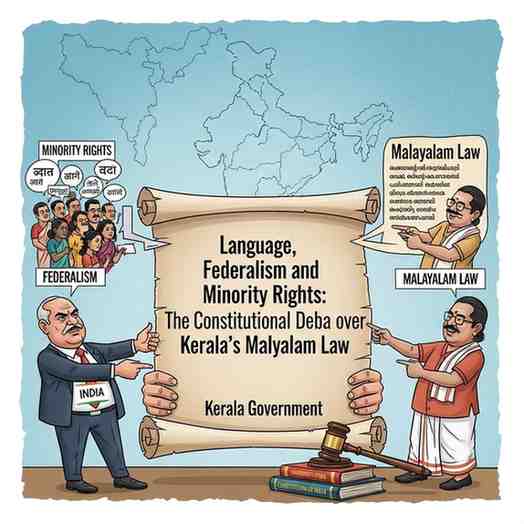
The Malayalam Language Bill and the Federal Test of Linguistic Balance
Language policy in India has rarely been a neutral administrative choice. It lies at the intersection of identity, education, federal autonomy and minority rights. The Malayalam Language Bill, 2025, passed by the Kerala Legislative Assembly, exemplifies this tension. While the Kerala government projects the law as a legitimate assertion of linguistic self-governance, objections from Karnataka have transformed it into an inter-State dispute, reopening older debates about how far a State can go in promoting its language without marginalising linguistic minorities.
The intent behind the Bill
The Malayalam Language Bill seeks to establish Malayalam as the principal language of governance in Kerala , extending its use across administration, education, courts, legislation and digital platforms. Among its most consequential provisions is the requirement that Malayalam be the compulsory first language in government and aided schools up to Class 10. The Bill also mandates the introduction of laws in Malayalam, translation of judicial proceedings, and the creation of new institutional mechanisms to develop the language in administration and technology.
For the Kerala government, the legislation corrects a historical anomaly. Despite Malayalam being the natural language of public life, English has continued to dominate official communication. The State argues that linguistic empowerment is essential for democratic access, cultural continuity and administrative inclusiveness. It also maintains that the Bill has been carefully drafted to avoid conflicts that led to the rejection of an earlier 2015 law.
Why Karnataka is concerned
The opposition from Karnataka centres on the status of Kannada-speaking minorities in Kerala’s border districts, particularly Kasaragod. Karnataka fears that making Malayalam the compulsory first language in schools could weaken existing Kannada-medium educational arrangements. Over time, this could reduce institutional support for Kannada and accelerate cultural assimilation.
The concern is not merely symbolic. Declining numbers of Kannada-medium schools are cited as evidence that linguistic space is already shrinking. Karnataka’s demand for exemptions for Kannada-speaking regions reflects a broader anxiety: that State-level language laws, even if well-intentioned, can have cumulative effects that erode minority languages in border areas.
Kerala’s defence and constitutional safeguards
Kerala has countered these objections by emphasising minority protections within the Bill itself. A key clause allows linguistic minorities to use their mother tongues for official communication in areas where they are substantially present. The State argues that the law is consistent with constitutional provisions that permit States to adopt their own official languages while safeguarding minority rights.
From Kerala’s perspective, allowing territorial exemptions would undermine the very idea of a coherent State language policy. It insists that promoting Malayalam does not imply suppressing other languages, but rather strengthening the primary medium of governance while accommodating diversity.
The deeper constitutional question
The controversy highlights a structural tension in Indian federalism. Articles of the Constitution grant States autonomy over official language policy, yet this autonomy is bounded by protections for linguistic minorities and by central legislation on education and official languages. When education is involved, the stakes rise further, as language choice shapes identity, opportunity and social mobility.
If the Bill receives assent without modification, it may still face judicial scrutiny, especially on whether compulsory language provisions in schooling disproportionately affect minorities. Conversely, if the Governor or President withholds assent, it could be seen as curbing State autonomy in cultural matters.
Month: Current Affairs - January 16, 2026
Category: