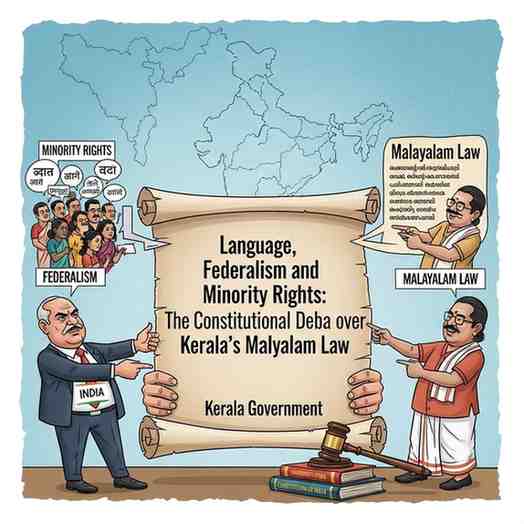
A test for cooperative federalism
Beyond Kerala and Karnataka, the episode has wider implications. India’s linguistic diversity is managed not by uniformity, but by negotiated coexistence. Border regions, where languages overlap, are particularly sensitive. Heavy-handed assertions—whether by States or the Centre—risk converting cultural policy into political conflict.
The Malayalam Language Bill thus becomes more than a regional law. It is a test of how India balances linguistic self-assertion with minority protection, and how disputes between States are resolved within constitutional frameworks rather than through escalation.
Conclusion
Language laws are most stable when they command trust across communities. Kerala’s effort to strengthen Malayalam reflects a legitimate aspiration to deepen democratic governance in a people’s language. Karnataka’s objections, equally, reflect legitimate concerns about minority erosion. Reconciling these claims will require dialogue, legal clarity and restraint. In a multilingual republic, linguistic pride must coexist with federal sensitivity—otherwise, cultural assertion risks becoming constitutional friction.
Month: Current Affairs - January 16, 2026
Category: