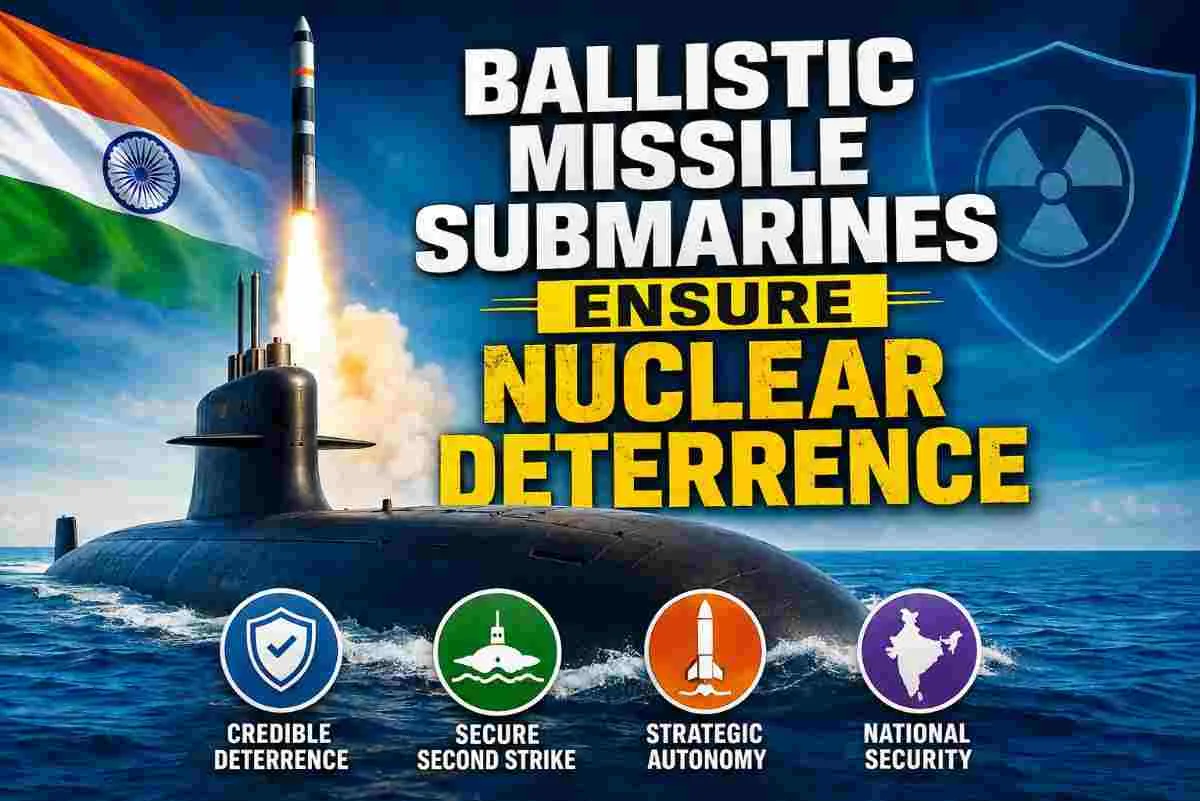
Overview :
India's nuclear triad relies on its sea-based leg for credible second-strike capability. The Arihant-class SSBNs (INS Arihant, Arighaat, Aridhaman) carry K-15 (750 km) and K-4 (3,500 km) missiles. Next-generation S5-class (13,500 tonnes) with K-5/K-6 MIRV missiles is under development. Project 77 will build six indigenous SSNs.
Nuclear Deterrence & India's SSBN Fleet
The Tea on Nuclear Deterrence
Here's the deal with nuclear deterrence. It's all about survival and retaliation.
The logic: If someone attacks you, you must survive and hit back. Hard. That's the deterrent.
The problem: Land-based missiles can be destroyed in a first strike. Bombers can be shot down. But submarines? They're hidden deep in the ocean.
The solution: Ballistic Missile Submarines (SSBNs). They're the most survivable leg of the nuclear triad.
The Nuclear Triad
| Leg |
Platform |
Survivability |
| Land-based |
ICBMs in silos |
Vulnerable to first strike |
| Air-based |
Strategic bombers |
Vulnerable to air defence |
| Sea-based |
SSBNs submerged |
Most survivable |
Classification of Modern Submarines
Navies classify submarines into three types based on propulsion and mission:
1. Diesel-Electric Attack Submarines (SSK)
| Aspect |
Details |
| Propulsion |
Electric batteries submerged; diesel on surface/with snorkel |
| Endurance |
A few days; with AIP up to 14 days |
| Mission |
Coastal defence, anti-submarine warfare, mine laying |
| Examples |
Kalvari-class (Scorpene), Shishumar-class (Type 209) |
2. Nuclear-Powered Attack Submarines (SSN)
| Aspect |
Details |
| Propulsion |
Nuclear reactor – no need for air |
| Endurance |
Limited by food (90+ days) |
| Mission |
Hunter-killer, fleet escort, land-attack cruise missiles |
| Examples |
US Virginia-class, Russian Akula-class |
3. Ballistic Missile Submarines (SSBN)
| Aspect |
Details |
| Propulsion |
Nuclear reactor |
| Endurance |
Limited by food (90+ days) |
| Mission |
Strategic deterrence – carry SLBMs with nuclear warheads |
| Examples |
India's Arihant-class, US Ohio-class, Russia's Borei-class |
Summary Table
| Type |
Propulsion |
Primary Role |
Endurance |
| SSK |
Diesel-electric |
Coastal defence, ASW |
2-14 days |
| SSN |
Nuclear reactor |
Hunter-killer, fleet escort |
90+ days |
| SSBN |
Nuclear reactor |
Strategic deterrence |
90+ days |
India's Sea-Based Deterrence: The Arihant-Class
India's nuclear triad was completed with the induction of indigenously built SSBNs under the Advanced Technology Vessel (ATV) project .
Current Fleet:
| Submarine |
Commissioned |
Key Features |
| INS Arihant (S2) |
August 2016 |
First indigenous SSBN; 83 MW reactor |
| INS Arighaat (S3) |
August 29, 2024 |
Upgraded sonar, noise reduction, propulsion |
| INS Aridhaman (S4) |
Under sea trials |
Larger, more launch tubes, enhanced quietness |
| S4 * |
Sea trials |
Final unit of transition phase |
Next-Generation S5-Class SSBNs
Bigger, better, stronger.
| Feature |
Specification |
| Displacement |
~13,500 tonnes (twice Arihant-class) |
| Propulsion |
190 MW compact light-water reactor (BARC) |
| Armament |
12-16 VLS tubes with ICBMs & MIRV technology |
Project 77: Indigenous Nuclear Attack Submarines (SSNs)
Formerly: Project 75 Alpha
Government Approval: October 2024 – CCS cleared first two SSNs.
| Feature |
Specification |
| Displacement |
~10,000 tonnes |
| Reactor |
190 MW |
| VLS Capacity |
24-cell Vertical Launch System for BrahMos-ER, Nirbhay, hypersonic missiles |
India's Submarine-Launched Ballistic Missiles (K-Missile Family)
The "K" series – named after Dr. APJ Abdul Kalam.
-
K-15 (Sagarika) – Range: 750 km. Deployed on the Arihant and Arighaat submarines, with 12 missiles each. Status: Operational.
-
K-4 – Range: 3,500 km. Deployed on the Aridhaman submarine, carrying 4 missiles. Status: Operational.
-
K-5 – Range: 5,000–6,000 km. Currently under development; deployment is yet to be finalised.
Month: Current Affairs - Aug 26, 2026
Category: Nuclear Deterrence