Overview
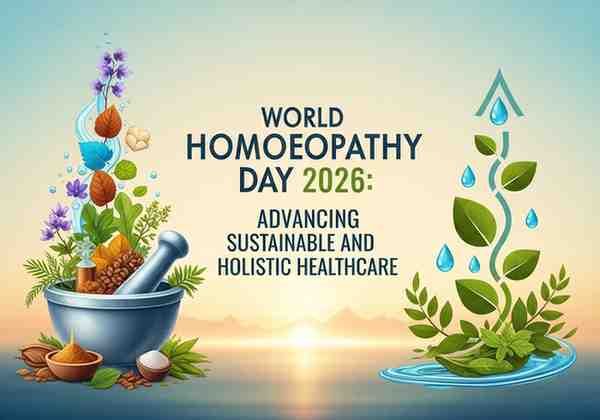
To commemorate the birth anniversary of Samuel Hahnemann, the father of homoeopathy, World Homoeopathy Day is celebrated on the 10 th of April every year. The theme of 2026, Homoeopathy for Sustainable Health, shows the increasing applicability of holistic and preventive healthcare systems. With the highest number of homoeopathic workers in the world, India is strategically placed to support the development of this medical system, including policy-wise, research and integration in the field of public health.
Theme and Significance
The 2026 theme focuses on creating an affordable, accessible and environmentally sustainable healthcare system. Homoeopathy is the therapy of the whole person and not of the isolated symptoms. This is in line with international concerns like preventive health and long term wellbeing, particularly with the increasing cases of lifestyle illnesses and healthcare expenditures. The day is observed by bodies such as the National Commission for Homoeopathy which conducts awareness campaigns and health programs.
Principles of Homoeopathy
There are two fundamental principles of homoeopathy. The first one is the like cures like, a notion that states that the same substances that cause the symptoms in healthy people can cure some of the same symptoms in patients. The second is the law of minimum dose where medicines are highly diluted and then used to promote the natural healing process in the body. Plant, mineral and animal sources are used to come up with remedies.
Growth of Homoeopathy in India
India has become a homoeopathy centre with a good institutional foundation comprising more than 3.45 lakh registered practitioners, thousands of dispensaries and many institutions of learning and research. Homoeopathy was introduced in the early 19 th century and through its successful treatment and its acceptance by the elites and ordinary people, it became popular.
Institutional and Policy Support.
The homoeopathy in India was enhanced by the post-independence developments. The major landmarks are the formation of the Central Council of Homoeopathy (1973) and Central Council of Research in Homoeopathy (1978). The system was further enhanced by the establishment of the Ministry of AYUSH in 2014 to develop the system via research schemes and the National AYUSH Mission.
Role in Public Health.
Homoeopathy has also been employed as a complementary medicine in dealing with epidemics. It has been used in outbreaks like Japanese Encephalitis in Uttar Pradesh, Chikungunya in Kerala, and during the COVID-19 in preventive remedies, which show its application in community-level healthcare.
Exam-Focused Key Points
- The World Homoeopathy Day is on April 10.
- Honours Samuel Hahnemann, the founder of homoeopathy.
- 2026 theme: “Homoeopathy to Sustainable Health.
- Based on principles of “like cures like” and minimum dose.
- Homoeopathy is encouraged in India by the ministry of AYUSH.
Month: Current Affairs - Apr 10, 2026
Category: Health | Government Policies