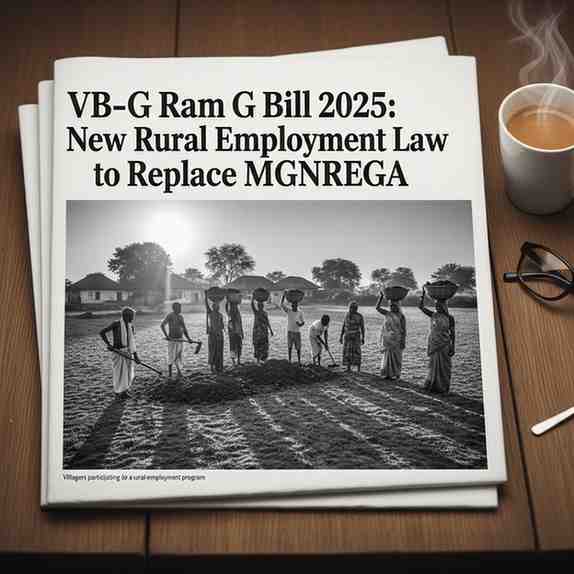
Viksit Bharat 2047 Vision Drives Major Reform in Rural Job Guarantee
The Union government is preparing to introduce the Viksit Bharat Guarantee for Rozgar and Ajeevika Mission (Gramin) Bill, 2025 in Parliament, proposing the repeal of the Mahatma Gandhi National Rural Employment Guarantee Act (MGNREGA) . The proposed legislation seeks to align rural employment policy with the long-term national vision of Viksit Bharat 2047 , focusing on sustainable livelihoods, durable infrastructure, and stronger governance.
Key Features of VB–G Ram G Bill
The Bill guarantees 125 days of wage employment per financial year to every rural household whose adult members are willing to undertake unskilled manual work. This represents a significant increase from the existing 100-day guarantee under MGNREGA. The law places equal emphasis on employment generation and long-term rural asset creation, aiming to convert public works into engines of lasting economic productivity.
Four Priority Development Verticals
All permissible works under the new framework will be organised into four strategic verticals: water security , core rural infrastructure (such as roads and connectivity), livelihood-supporting infrastructure (including storage and market facilities), and climate-resilience and disaster mitigation works . Assets created will be mapped into a Viksit Bharat National Rural Infrastructure Stack to improve coordination, monitoring, and planning at the national level.
Structural Shift From MGNREGA
Unlike the earlier demand-driven funding model, VB–G Ram G introduces normative budget-based funding while retaining statutory employment guarantees. Planning will be decentralised through Viksit Gram Panchayat Plans , integrated with national platforms like PM Gati-Shakti , promoting outcome-oriented and geographically coherent infrastructure development.
Expected Impact on Rural Economy
Farmers are expected to benefit from improved irrigation, storage, and climate-resilient infrastructure, while safeguards such as work pauses during peak agricultural seasons aim to prevent labour shortages. Rural workers gain higher guaranteed employment, predictable work cycles, digital wage payments, and unemployment allowance where work is not provided. States will implement the scheme under a centrally sponsored structure with enhanced accountability.
Exam-Focused Points
-
VB–G Ram G Bill guarantees 125 days of rural employment annually.
-
It proposes to replace MGNREGA in line with Viksit Bharat 2047 .
-
Rural works are organised into four priority infrastructure verticals .
-
Funding shifts from demand-based to normative budgeting .
Month: Current Affairs - December 16, 2025
Category: Indian Polity, Rural Development