Context:
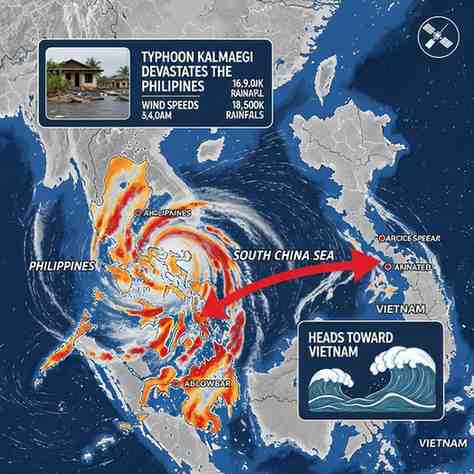
- Typhoon Kalmaegi has emerged as the deadliest storm in Asia in 2025 , leaving widespread destruction across the Philippines and now threatening central Vietnam . The typhoon intensified rapidly over the South China Sea , bringing heavy rainfall, flash floods, and powerful winds that caused extensive human and economic losses.
Impact on the Philippines
-
Death Toll: At least 114 people killed, mostly due to drowning.
-
Worst-Hit Area: Cebu province , especially Talisay and Cebu City , where the Mananga River overflowed, flattening homes and inundating roads.
-
Rescue Operations:
-
Thousands evacuated to temporary shelters like schools and churches.
-
Roads and bridges destroyed, complicating relief work.
-
State Response: The Philippines government declared a state of national calamity to mobilize aid and restore critical infrastructure.
-
Economic Damage: Massive losses in housing, transport, and agriculture sectors, aggravated by a recent 6.9 magnitude earthquake that had already strained resources.
Why Typhoon Kalmaegi Was So Destructive
-
Slow Movement: After landfall, the typhoon moved slowly across densely populated terrain, dumping extreme rainfall.
-
Topography: Cebu’s hilly landscape funneled runoff into low-lying areas, triggering flash floods.
-
Main Cause of Death: Flooding, not wind, was the primary killer — a recurring pattern in tropical cyclones.
-
Rainfall Intensity: Some regions recorded 150–250 mm in 24 hours , overwhelming local drainage systems.
Threat to Vietnam
-
Current Strength: Kalmaegi has strengthened to a Category 4 equivalent storm with winds near 215 km/h .
-
Expected Landfall: Central Vietnam, particularly Danang, Quang Ngai, and Dak Lak provinces , expected to be hit on Thursday night .
-
Evacuations: Authorities plan to relocate around 350,000 people in Gia Lai province alone.
-
Risks: Strong winds, storm surges, and flash floods across the coastal plains.
-
Context: The region is still recovering from recent floods that submerged the UNESCO World Heritage site Hoi An and disrupted transport and power supply.
-
Additional Threat: A secondary system , Tropical Storm Fung-Wong (Uwan) , could intensify and bring more rain to northern Luzon, compounding flood risks.
Climate and Environmental Significance
Exam-Oriented Facts
-
Name: Typhoon Kalmaegi – Deadliest Asian typhoon of 2025 .
-
Philippines Death Toll: 114+ fatalities , mainly due to flooding.
-
Rainfall: 150–250 mm in 24 hours in central Philippines.
-
Vietnam Preparedness: ~350,000 people evacuated in Gia Lai province.
-
Category: Strengthened to Category 4 equivalent over the South China Sea .
-
Climate Signal: Driven by warmer seas and higher moisture levels .
-
Tropical Storm Fung-Wong: May intensify and threaten northern Luzon next.
Conclusion
Typhoon Kalmaegi is a stark reminder of how warming oceans and erratic weather patterns amplify the severity of tropical cyclones. For the Philippines and Vietnam, it underscores the urgent need to strengthen disaster preparedness , urban drainage infrastructure , and climate resilience policies.
Month: Current Affairs - Nov 06, 2025
Category: Geography / Environment & Ecology