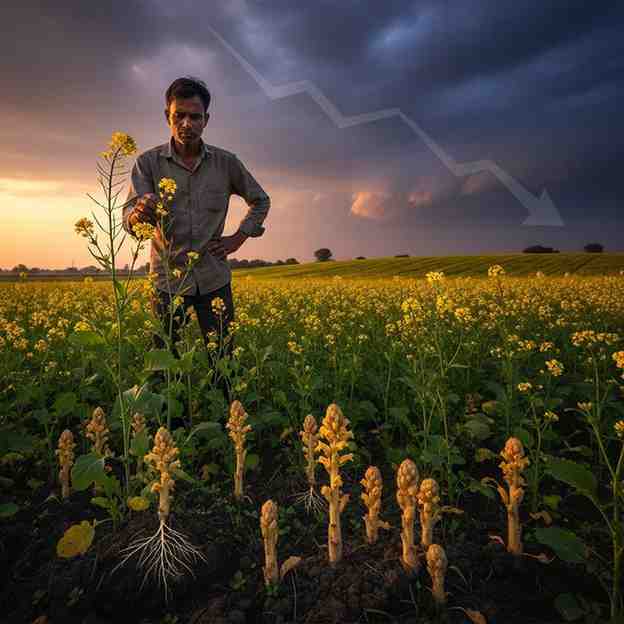
India's Mustard Crisis: The Underground Weed Undermining Edible Oil Self-Sufficiency
India's quest for self-reliance in edible oils faces a mounting, hidden challenge from a parasitic weed, Orobanche aegyptiaca . Mustard, cultivated on nearly 9 million hectares across the states of Rajasthan, Uttar Pradesh, Madhya Pradesh, Haryana, and West Bengal, is the country's largest home-grown source of edible oil. However, rising infestations of this root parasite are causing significant yield losses, directly impacting domestic production and import substitution goals.
The Stealthy Parasite and Its Mounting Toll
Commonly known as margoja , Orobanche aegyptiaca is a non-photosynthetic weed that attaches itself to the roots of mustard plants. It acts as a direct siphon, diverting essential nutrients, water, and carbon from the host crop. This results in visible symptoms like wilting, yellowing, and severe stunting of plants, drastically reducing seed formation and yield.
The insidious nature of the threat lies in its subterranean early growth. By the time the pale, flowering spikes of Orobanche emerge above the soil, the damage to the mustard crop is already extensive and irreversible. Compounding the problem, each Orobanche plant produces thousands of microscopic seeds that can persist in the soil for up to 20 years , creating a long-term "seed bank" that makes eradication extremely difficult.
Farmers in key regions are reporting stark losses. In Haryana's Sirsa district, for instance, average yields have plummeted from a robust 9-12 quintals per acre to nearly 6 quintals per acre in the 2024-25 season , despite adherence to conventional pest management practices.
Strategic Implications for National Edible Oil Security
The ramifications extend far beyond individual farms. Mustard contributes over 4 million tonnes to India's annual indigenous edible oil production, which stands at approximately 10.5-10.6 million tonnes . With the nation importing a staggering nearly 16 million tonnes of edible oils annually—costing over $18 billion in foreign exchange—every tonne lost to Orobanche deepens import dependency.
This biological challenge, coupled with existing threats from pests and diseases, directly undermines national missions like Atmanirbhar Bharat (self-reliant India) in the critical edible oils sector.
The Technological Crossroads and Policy Imperatives
Current chemical control options are limited. Broad-spectrum herbicides like glyphosate cannot be used on standing conventional mustard without damaging the crop. This has spurred the development of new agronomic solutions:
-
Herbicide-Tolerant (HT) Hybrids: Non-GM hybrids tolerant to specific herbicides like imidazolinone are seeing farmer adoption, allowing selective spraying of the parasitic weed.
-
Genetically Modified (GM) Mustard: Scientists have developed GM mustard lines, such as those from the University of Delhi, engineered for resistance to multiple herbicides, offering a potent tool for integrated Orobanche management.
Policymakers now face a critical juncture. Balancing science, farm economics, and long-term food security requires decisive action on the approval and deployment of advanced breeding technologies. The choice will significantly influence the future resilience and productivity of India's primary indigenous oilseed crop.
🔍 Exam-Focused Points (Important Facts)
-
The parasitic weed threatening Indian mustard is Orobanche aegyptiaca , locally called margoja .
Month: Current Affairs - January 14, 2026
Category: Agriculture-FoodSecurity