Overview
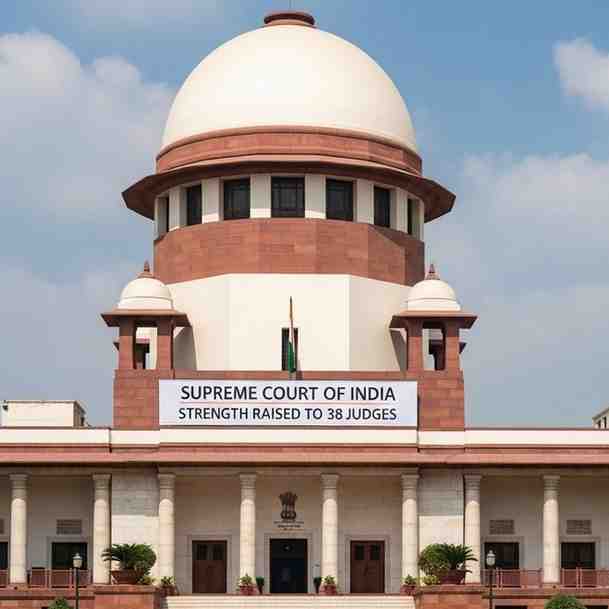
The Supreme Court of India will now have more judges. The government has increased the number of judges from 34 to 38. This includes the Chief Justice of India. The change was made through an ordinance on 16 May 2026. The President promulgated it. The move aims to reduce the huge pile of pending cases.
What Has Changed?
Earlier, the Supreme Court had:
Now, after the ordinance:
-
1 Chief Justice of India
-
37 other judges
-
Total strength: 38
So, four new judge positions have been added.
How Was This Done?
The government used an ordinance . An ordinance is a law that the President can make when Parliament is not in session. This power comes from Article 123 of the Constitution.
-
President Droupadi Murmu promulgated the ordinance on 16 May 2026 .
-
The ordinance was published in the Gazette of India on the same day.
-
It is called the Supreme Court (Number of Judges) Amendment Ordinance, 2026 .
The ordinance changes Section 2 of the Supreme Court (Number of Judges) Act, 1956 . The old number “thirty-three” has been replaced with “thirty-seven”.
Why Was This Needed?
The Supreme Court has a very large number of pending cases. As of now, over 93,000 cases are waiting for hearing. More judges can hear more cases. This will help reduce the delay in justice.
The Union Cabinet approved this proposal on 5 May 2026 . The Cabinet is chaired by Prime Minister Narendra Modi.
What Happens Next?
An ordinance is a temporary law. It must be replaced by a regular Act of Parliament. Parliament must pass a Bill within six weeks of its next session. Both Houses (Lok Sabha and Rajya Sabha) need to approve it. Then it becomes a permanent law.
Important Facts for Exams
| Fact |
Detail |
| Old strength (including CJI) |
34 |
| New strength (including CJI) |
38 |
| Old strength (excluding CJI) |
33 |
| New strength (excluding CJI) |
37 |
| Ordinance date |
16 May 2026 |
| President who promulgated |
Droupadi Murmu |
| Constitutional article for ordinance |
Article 123 |
| Base Act amended |
Supreme Court (Number of Judges) Act, 1956 |
| Last increase before this |
2019 (from 30 to 33 excluding CJI) |
| Supreme Court established under |
Part V, Chapter IV of Constitution |
| Original strength in 1950 |
1 CJI + 7 puisne judges (total 8) |
| Pending cases |
Over 93,000 |
| Cabinet approval date |
5 May 2026 |
Exam-Focused Points
-
The Supreme Court’s total strength (including CJI) is now 38 .
-
Number of judges excluding CJI has increased from 33 to 37 .
-
This was done through the Supreme Court (Number of Judges) Amendment Ordinance, 2026 .
-
President Droupadi Murmu promulgated it on 16 May 2026 .
-
The ordinance is based on Article 123 of the Constitution.
-
The last increase in judge strength was in 2019 .
-
The Supreme Court currently has a pendency of over 93,000 cases .
-
The Union Cabinet approved the proposal on 5 May 2026 .
-
The ordinance must be replaced by an Act of Parliament within six weeks of the next session.
-
The Supreme Court was established under Part V, Chapter IV of the Constitution.
Frequently Asked Questions (FAQ)
Q1: How many judges does the Supreme Court now have in total?
A: The Supreme Court now has 38 judges in total, including the Chief Justice of India.
Q2: What is an ordinance?
A: An ordinance is a temporary law made by the President when Parliament is not in session. It has the same force as an Act of Parliament.
Q3: Which article of the Constitution allows the President to make ordinances?
A: Article 123 gives the President the power to promulgate ordinances.
Q4: When was the last time the Supreme Court’s judge strength was increased?
A: The last increase was in 2019, when the number of judges (excluding CJI) rose from 30 to 33.
Q5: Why did the government increase the number of judges?
A: The government increased the number to help reduce the huge backlog of over 93,000 pending cases in the Supreme Court.
Month: Current Affairs - May 18, 2026
Category: Ordinance 2026-Article 123