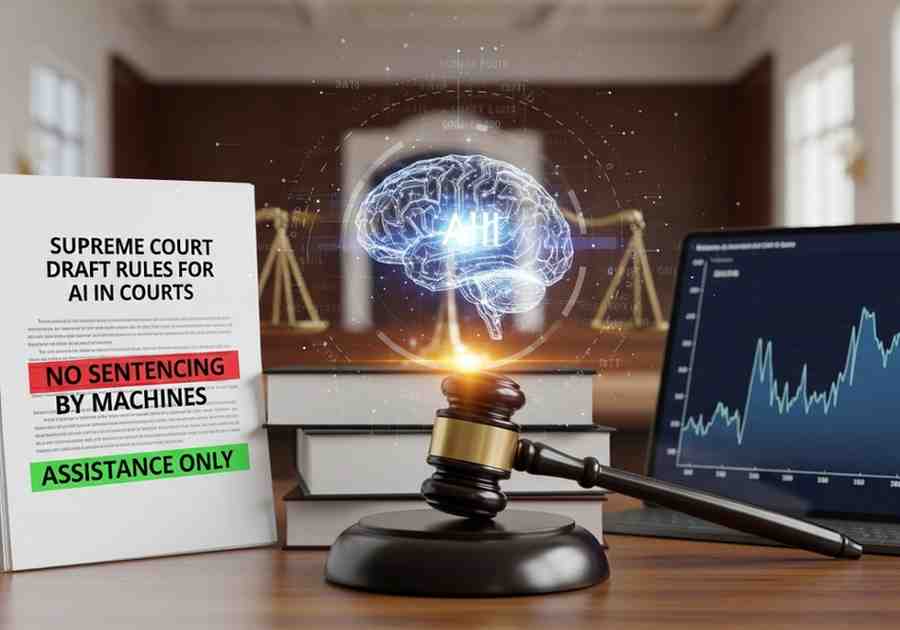
assist judges. The final outcome must be decided by a human judicial officer. AI systems that cannot explain their reasoning are banned if they affect rights or liberty.
Q2: What is the “human-in-the-loop” requirement?
A: It means that for any sentencing or adjudicative function involving AI, a human judge must be actively involved in the decision-making process. AI outputs are advisory only.
Q3: Why are black box AI systems banned?
A: Because if an AI cannot explain how it reached a conclusion, there is no way to check whether it was biased or made a mistake. This violates the principles of fairness and accountability in justice.
Q4: Who can comment on the draft regulations?
A: The Supreme Court AI committee has invited comments and suggestions from stakeholders as well as members of the general public. The last date is 20 June 2026.
Q5: Will law students need to learn about AI now?
A: Yes. The Bar Council of India has already instructed universities to include AI in law curricula. The draft regulations make it essential for students to understand what AI can and cannot do in court, and the ethical rules for using AI in legal practice.
Month: Current Affairs - Jun 15, 2026
Category: SupremeCourtAIRegulations