Overview :
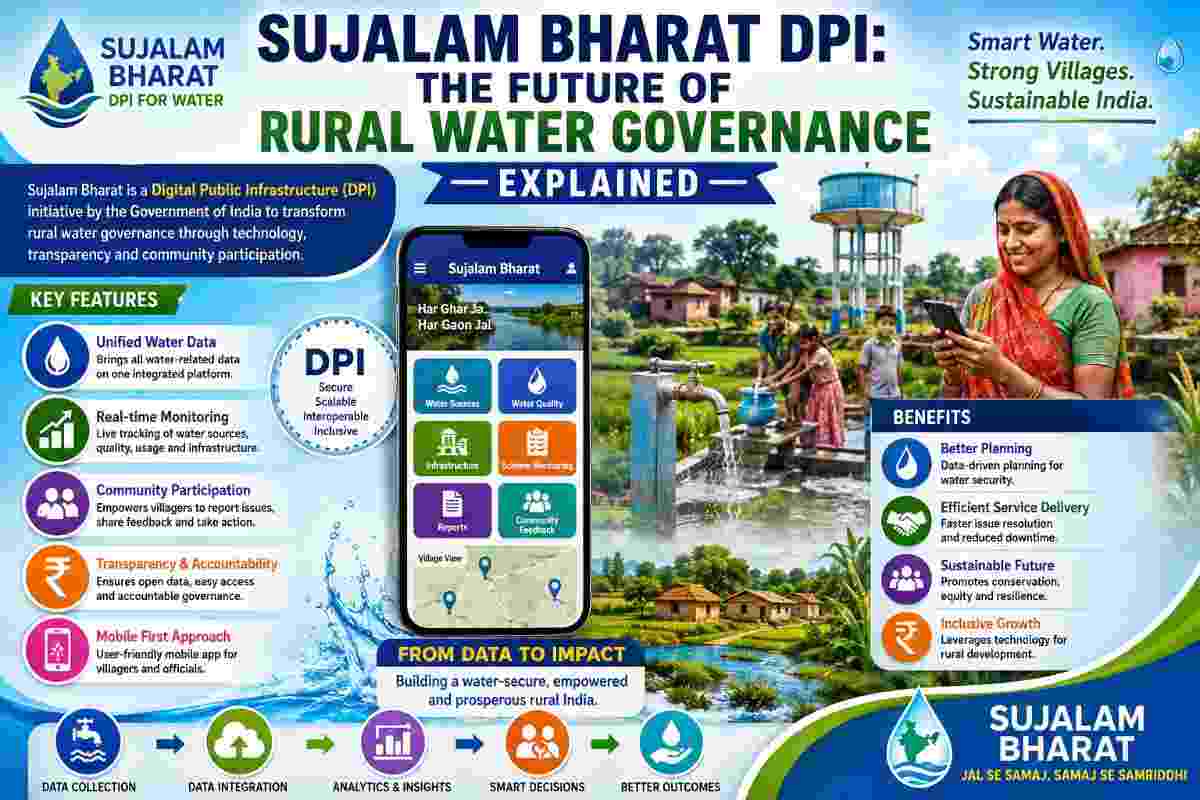
The Ministry of Jal Shakti issued a new Policy on Data Sharing, Interoperability and Stakeholder Access on August 20, 2026. It builds on the Sujalam Bharat Digital Public Infrastructure to streamline data sharing in India's rural drinking water sector, empowering Gram Panchayats with advanced digital tools.
What Is Digital Public Infrastructure (DPI)?
Digital Public Infrastructure refers to shared digital systems that enable large-scale public service delivery. Think of it as the digital plumbing for governance. The UPI for payments is a classic example; Sujalam Bharat is the DPI for rural water.
Why a Data Policy?
The policy standardises how data is shared across states and districts. Common identifiers and interoperable registries ensure that water quality data, asset maps, and service records are compatible across the entire system.
What Are Digital Twins?
A Digital Twin is a virtual model of a physical system. In this context, it could be a digital replica of a village's water supply network, enabling real-time monitoring and predictive maintenance.
The Gram Panchayat Focus
The policy provides GPs with direct access to data and analytical tools, shifting the focus to local-level service delivery and accountability.
Jal Jeevan Mission 2.0
This policy is part of the next phase of the Jal Jeevan Mission, which aims to provide Functional Household Tap Connections to all rural households.
Exam-Focused Points :
-
Issued By Department of Drinking Water and Sanitation, Ministry of Jal Shakti.
-
Date 20 August 2026.
-
Framework Sujalam Bharat Digital Public Infrastructure.
-
Sector Rural drinking water sector.
-
Key Feature Federated data-sharing framework for Centre, States, UTs, and Gram Panchayats.
-
Technologies AI-enabled analytics, geospatial planning, water-quality monitoring, and Digital Twins.
-
Gram Panchayat Role Expanded role in asset monitoring, grievance redressal, and service accountability.
FAQs :
Q1: What is the purpose of this policy?
To establish a data-sharing framework for the rural drinking water sector under the Jal Jeevan Mission.
Q2: What is Sujalam Bharat?
A Digital Public Infrastructure for India's rural drinking water sector.
Q3: What technologies are enabled by this policy?
AI, geospatial planning, water-quality monitoring, and Digital Twins.
Q4: What is a federated framework?
A system where multiple administrative levels share data through common rules while maintaining their own records.
Q5: What is Gram Panchayat's role under this policy?
They will be empowered in participatory asset monitoring, grievance redressal, and service accountability.
Month: Current Affairs - Aug 21, 2026
Category: Jal Jeevan Mission