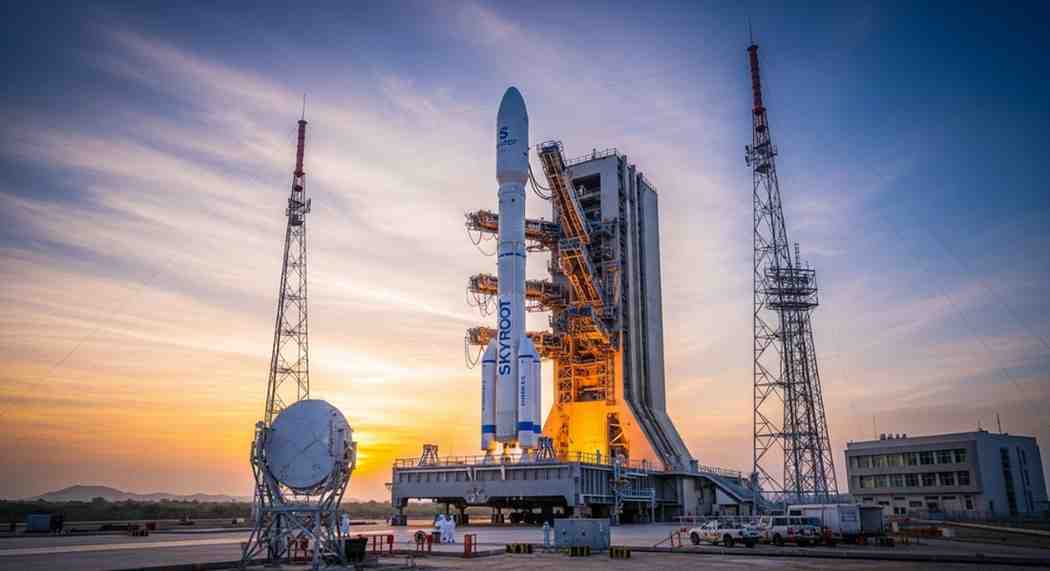
Vikram-1 Mission Marks Major Milestone for India’s Private Space Industry
India’s private space sector is approaching a landmark moment as Skyroot Aerospace prepares to launch Vikram-1 , the country’s first privately developed orbital launch vehicle. The mission reflects the rapid expansion of India’s commercial space ecosystem, where startups are working to provide flexible and cost-effective satellite launch services.
Founded in 2018 by former ISRO engineers Pawan Kumar Chandana and Naga Bharath Daka, the Hyderabad-based company aims to target the growing market for small satellite launches.
Vikram-1 Launch Vehicle
Vikram-1 is a three-stage launch vehicle approximately 75 feet tall , designed to deliver satellites weighing up to 300 kg into low Earth orbit. The rocket is part of the Vikram series and is named after Vikram Sarabhai.
The launch vehicle incorporates an all-carbon composite structure to reduce weight and improve performance. Its propulsion system includes three solid-fuel stages — Kalam-1200, Kalam-250 and Kalam-125 . The upper orbit adjustment module uses a 3D-printed liquid engine called Raman-2 , which allows precise orbital manoeuvring.
The rocket’s final integration and testing are underway at Skyroot’s Max-Q headquarters in Hyderabad , with the first launch expected from the Satish Dhawan Space Centre in Sriharikota.
Dedicated Launch Services for Small Satellites
Skyroot Aerospace is focusing on the specialised market of dedicated small-satellite launches . Unlike large rockets that carry multiple satellites in shared missions, Skyroot aims to offer customised launch services placing payloads into precise orbits.
The company often describes its service model as a “space cab” , enabling satellite operators to deploy communication, earth-observation or research satellites without waiting for shared launch schedules.
Technology and Production Infrastructure
To improve efficiency and reduce launch costs, Skyroot uses advanced carbon-fibre materials and additive manufacturing techniques . Its Infinity Campus in Hyderabad is designed to support scalable production, with the long-term goal of building one Vikram-class rocket per month .
The startup has also signed launch agreements and technology partnerships with domestic and international space companies, strengthening its commercial launch pipeline.
Important Facts for Exams
-
Skyroot Aerospace launched Vikram-S , India’s first private sub-orbital rocket , in November 2022.
-
Vikram-1 can carry satellites of up to 300 kg to low Earth orbit.
-
The rocket uses a 3D-printed liquid engine called Raman-2 .
-
India’s private space ecosystem expanded after regulatory reforms through IN-SPACe.
Future Outlook for India’s Commercial Space Sector
Skyroot plans to make satellite launches more frequent and affordable while eventually developing larger and reusable launch vehicles. Future missions may also operate from upcoming private launch infrastructure such as the Kulasekarapattinam Spaceport.
Alongside emerging companies like Agnikul Cosmos, Skyroot Aerospace
Month: Current Affairs - March 06, 2026
Category: Space Technology | Private Space