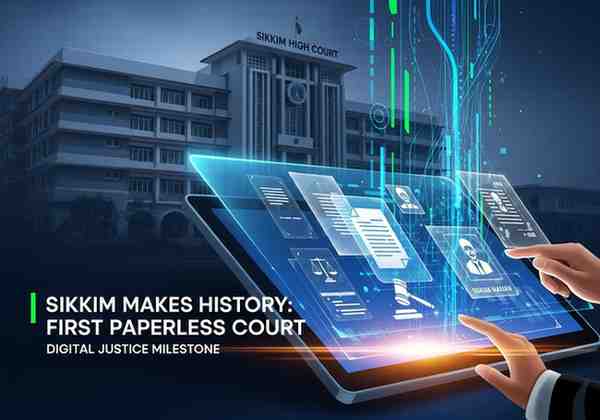
being reformed digitally:
- Courts are now able to connect with remote areas online.
- The expenses of travelling are minimised.
- Time delays are reduced to the minimum.
It is particularly helpful in such places as North Sikkim. It is also beneficial to island territory and rural regions of India.
The outcome is a more equal justice system.
The advantages of Paperless Judiciary.
Switching to the digital court is accompanied by numerous benefits:
1. Faster Case Processing
Digital systems minimize the use of paperwork and accelerate the process.
2. Cost Reduction
Less money is spent on paper, storage and logistics.
3. Greater Transparency
The details of the cases can be found online. This brings confidence in the system.
4. Environmental Benefits
Less use of paper is a way of preserving the environment.
5. Better Record Management
Digital storage eliminates loss or damage of valuable documents.
The role of National Judicial Reforms.
Digital courts have been on the agenda of India several years. One of the most important projects that became a part of this journey is the e-Courts Mission Mode Project.
It aims to:
- Digitize court records
- Enable online services
- Improve judicial efficiency
The success of Sikkim is a sign that such reforms are effective. It also gives a pattern to be followed by other states.
Way Forward and Challenges.
Although the development is robust, there are still certain difficulties:
- Internet connectivity in the rural areas should be improved.
- Education of legal experts to use digital tools.
- Cybersecurity concerns
These problems will be solved to achieve success in the long term.
Sikkim can now serve as a role model to other states. A completely digital judicial system can be achieved through gradual adoption in the entire of India.
Exam-Focused Key Points
- Sikkim is the first all-paperless judiciary in India.
- Announcement made by Chief Justice Surya Kant
- Proclaimed in a national conclave at Gangtok.
- The transformation was headed by High Court of Sikkim.
- Important tools: e-Courts Project, SUPACE, SUVAS.
- Features: e-filing, virtual hearing, digital records.
- Intent: Enhance access, velocity and transparency.
- Advantages: Less expensive, quicker justice, environmental benefits.
Frequently Asked Question (FAQ)
1. What is meant by a paperless judiciary?
It implies that
Month: Current Affairs - May 04, 2026
Category: Judiciary | Governance