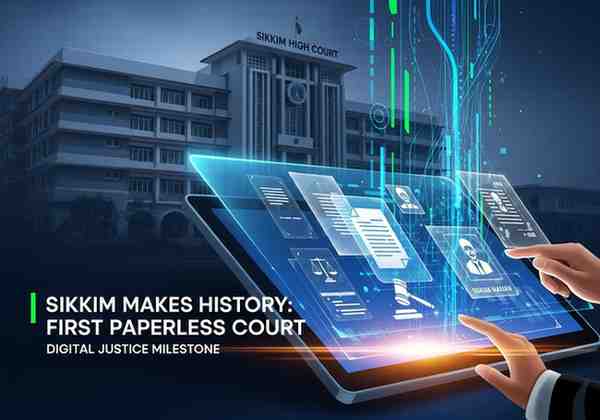
Introduction: A New Era in the Justice System in India.
India has made a significant move towards digital governance. Sikkim is the first state in the nation to attain a totally paperless judicial system. This was announced by Surya Kant at a national conclave at Gangtok.
This trend can be seen as a definite change in the way of the functioning of the courts. It shifts the system off the physical paperwork. It also renders justice delivery quicker, easier and more affordable
The State of Sikkim is a National Standard.
Sikkim has developed a good model to be followed by the rest of India. It is the first state in which the entire process of courts is digital.
High court of Sikkim was instrumental in this change. The court substituted the old paper-based systems with electronic systems.
This is a significant step forward in the judicial reforms in India. It demonstrates ways in which technology can enhance the governance and public services.
Vision: Justice Should Travel, Not People.
One of the fundamental concepts of this reform is straightforward. Individuals do not have to go far to get justice.
This vision is important for states like Sikkim. The area is rugged and remote. Commute to courts can be time consuming and expensive.
With digital systems:
- Cases can be registered online by the citizens.
- Real time monitoring of case status can be done.
- Digitally, court orders can be accessed.
This will be more inclusive and realistic in the delivery of justice.
What Is a Paperless Courts System?
Paperless judiciary refers to the fact that all court activities are performed in a digital manner. There are no actual documents needed.
Key features include:
- E-filing of cases
- Electronic storage of records.
- Virtual court hearings
- Judgments access online.
This system minimizes delays. It also enhances efficiency and transparency.
Technology that is Underlying the Transformation.
This transition has been facilitated by some digital tools. These are the tools that are the foundation of the contemporary courts.
Important initiatives include:
- The e-Courts Project, a project that modernizes the court infrastructure.
- AI applications such as SUPACE to research the law.
- SUVAS to translate legal documents.
Moreover, virtual hearings and online case management systems have enhanced the functioning of the courts.
The technologies minimize manual labor. They are also useful in enabling the judges and lawyers to manage cases more effectively.
Enhancing Access to Remote Areas.
The judicial system in India has long had difficulties in the remote regions. The residents of these areas usually find it difficult to access courts.
This situation is
Month: Current Affairs - May 04, 2026
Category: Judiciary | Governance