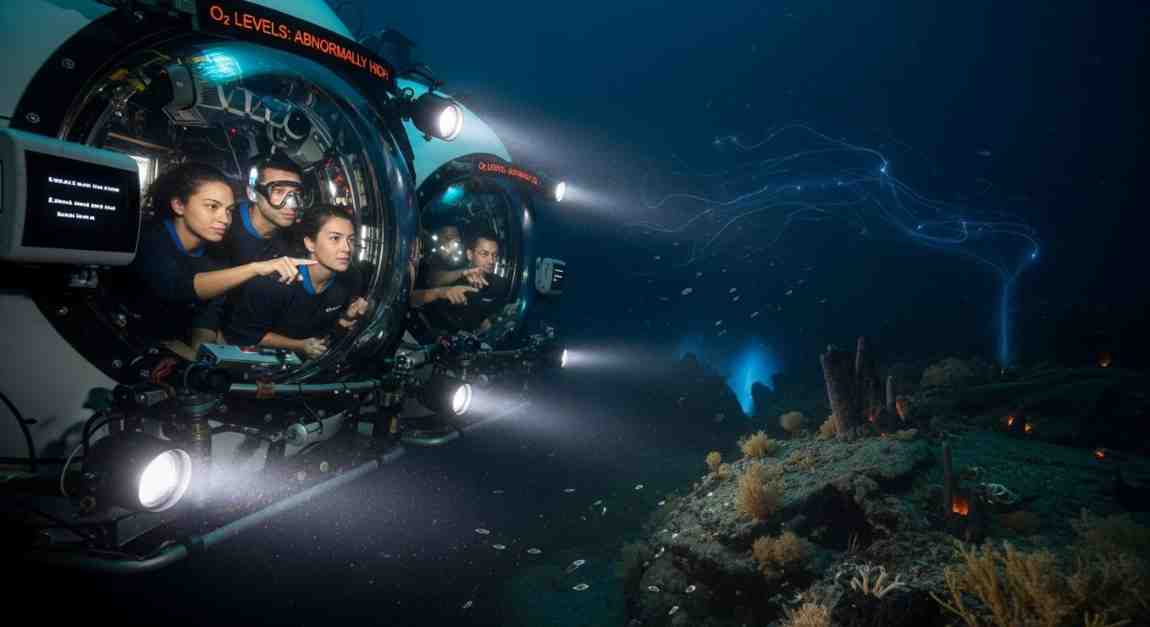
Deep-Sea Study Reveals Oxygen Production Near Polymetallic Nodules
Scientists investigating the deep Pacific Ocean have reported the detection of “dark oxygen” nearly 4,000 metres below the surface—an environment where sunlight cannot penetrate. The discovery challenges the long-held belief that oxygen on Earth is produced mainly through photosynthesis, which requires sunlight. The findings emerged from research conducted on mineral-rich formations on the ocean floor and have opened new debates about oxygen generation in extreme environments.
Understanding “Dark Oxygen”
The term “dark oxygen” refers to oxygen detected in deep-sea regions where light-dependent biological processes cannot occur. Traditionally, atmospheric oxygen is generated through Photosynthesis, carried out by plants, algae and certain bacteria that use sunlight to convert water and carbon dioxide into oxygen.
However, scientists discovered measurable oxygen concentrations in areas where sunlight never reaches. The study, published in Nature Geoscience, found that oxygen levels near deep-sea mineral deposits increased during controlled experiments on the ocean floor.
Detection in the Deep Pacific
The research took place in the Clarion Clipperton Zone, an extensive area known for its abundance of mineral nodules. Scientists used specialised instruments and benthic chambers to isolate small sections of the seabed and track chemical changes over time.
Instead of declining—as expected due to microbial consumption—oxygen levels increased inside the chambers. To ensure accuracy, researchers repeated the experiments multiple times and conducted laboratory tests to eliminate the possibility of measurement errors.
Possible Role of Polymetallic Nodules
The team suggests that Polymetallic Nodules may play a crucial role in generating oxygen. These nodules contain metals such as manganese, nickel and cobalt and accumulate slowly over millions of years.
Scientists believe the nodules might enable electrochemical reactions that split seawater molecules into hydrogen and oxygen. In effect, these mineral formations could act like natural batteries capable of producing oxygen even in complete darkness. Further research is required to confirm this mechanism.
Important Facts for Exams
-
Photosynthesis is the primary process responsible for oxygen production on Earth.
-
The Clarion–Clipperton Zone in the Pacific Ocean contains large deposits of polymetallic nodules.
-
These nodules form slowly on abyssal plains over millions of years.
-
Nature Geoscience publishes research related to Earth and environmental sciences.
Broader Scientific Significance
The discovery may reshape understanding of the global oxygen cycle and highlight previously unknown chemical processes occurring in deep-sea ecosystems. It could also influence research in astrobiology, where oxygen is often considered an indicator of life on other planets.
If oxygen can form through purely chemical reactions in dark environments, scientists may need to reconsider assumptions about detecting life beyond Earth. The findings also raise environmental concerns regarding deep-sea mining, as disturbing mineral nodules could disrupt fragile ecosystems that remain largely unexplored.
Month: Current Affairs - March 05, 2026
Category: Science | Oceanography