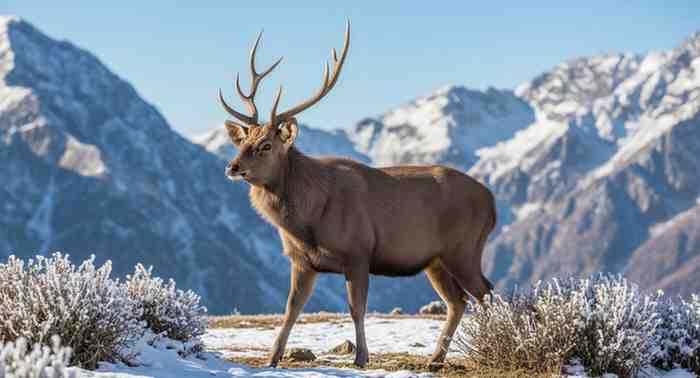
Camera Traps Reveal Presence of Sambar Deer in Chamba’s Himalayan Wildlife Sanctuaries
The Himachal Pradesh Forest Department has documented the presence of Sambar Deer in high-altitude protected areas of Chamba District for the first time. The discovery was made through camera trap monitoring conducted in wildlife sanctuaries of the region. This finding is notable because the species is typically associated with the lower Shivalik hills and moist deciduous forests rather than high Himalayan elevations. The observation has been published in the February quarterly issue of the Zoological Survey of India journal Records of the Zoological Survey of India .
Discovery Through Camera Traps
Forest officials captured images of sambar deer in Kalatop-Khajjiar Wildlife Sanctuary and Gamgul Wildlife Sanctuary . Camera traps recorded both adult and sub-adult males visiting a water source, with most sightings occurring during evening and nighttime hours. These records suggest that the species may be gradually expanding its habitat range into higher Himalayan zones.
High-Altitude Habitat Conditions
Kalatop-Khajjiar Wildlife Sanctuary is situated at elevations exceeding 2,500 metres , while Gamgul Wildlife Sanctuary rises above 3,000 metres above sea level. The presence of sambar deer in these areas may be supported by dense coniferous forests , abundant water sources and relatively undisturbed natural habitats. Such ecological conditions provide adequate shelter and forage for large herbivores in mountainous environments.
Coexistence with Other Deer Species
Researchers also noted the presence of multiple deer species within the same landscape of Kalatop-Khajjiar. Along with the sambar deer, both Musk Deer and Barking Deer were recorded in the sanctuary. These species usually occupy distinct ecological niches, making their coexistence in the same region a noteworthy observation for wildlife scientists.
Exam-Focused Key Points
-
Sambar Deer: Largest deer species found in South Asia.
-
Conservation Status: Listed as Vulnerable on the International Union for Conservation of Nature Red List.
-
Protected under Schedule III of the Wildlife Protection Act 1972 .
-
Chamba district hosts several protected areas including Kalatop-Khajjiar, Gamgul, Kugti, Tundah and Sechu Tuan Nala sanctuaries.
Month: Current Affairs - Mar 09, 2026
Category: Environment & Biodiversity